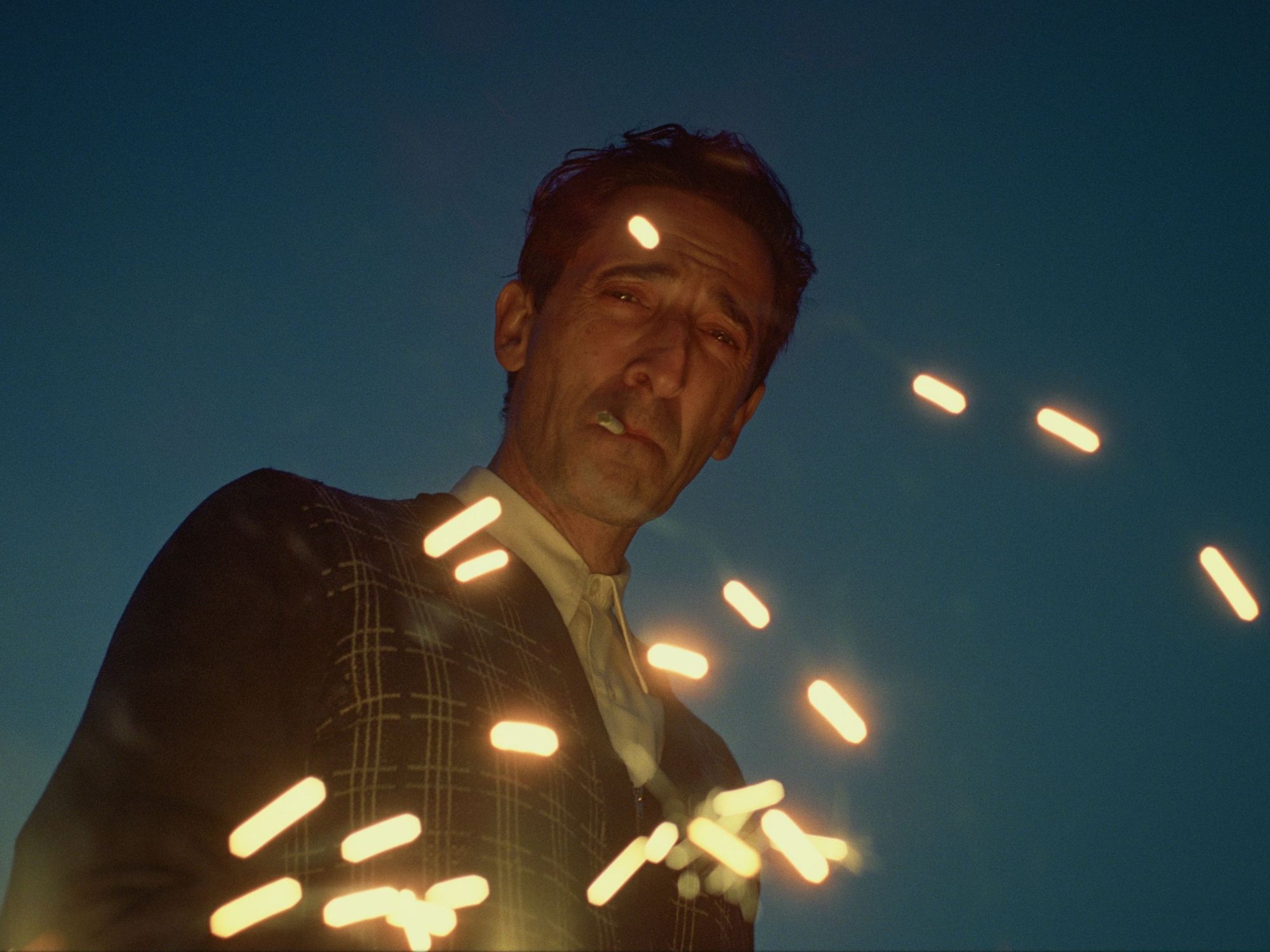
After its debut at the Venice International Film Festival, writer and director Brady Corbet’s third feature, The Brutalist, has been the talk of the awards circuit during the first half of the season. This film came as a surprise to me; I wasn’t aware of it until the festival. A24 has picked up the distribution rights, and I’ve been eagerly waiting to see when it will expand beyond New York and Los Angeles. Based on everything I’ve heard over the past few months, I approached this film with two minds, wondering whether it would be an actual awards contender or simply a film that wouldn’t resonate with general audiences seeking something more. By the end, you have a three-and-a-half-hour epic drama to get swept up in that won’t be forgotten for days to come. Who would’ve thought the teenage lead from the terrible Thunderbirds movie would go on to direct a damn great film two decades later?
What’s the Story: Escaping post-war Europe, Hungarian-Jewish architect László Tóth (Adrien Body) arrives in America in 1947 to rebuild his life, his work, and his marriage to his wife Erzsébet (Felicity Jones) after being forced apart during wartime by shifting borders and regimes. On his own in a strange new country, László settles in Pennsylvania, where the wealthy and prominent industrialist Harrison Lee Van Buren (Guy Pierce) recognizes his talent for building. But power and legacy come at a heavy cost.
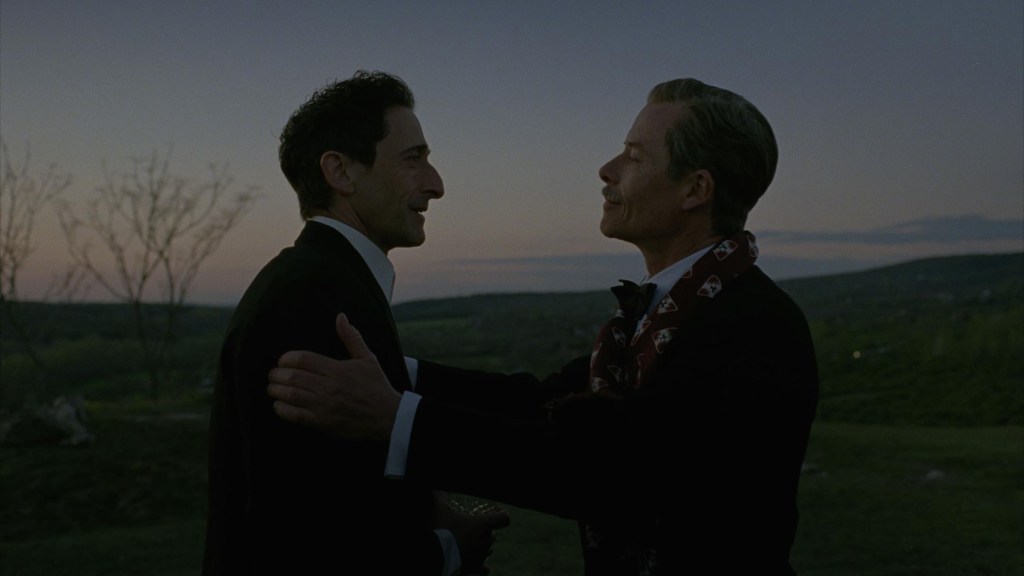
When telling an immigrant story, especially one of survivors from the Holocaust, it is essential to understand their experience of starting a new life in a different country. Viewing this from László’s perspective, the path to achieving anything worthwhile is often challenging, particularly for an artist facing difficult times. He arrives in America to stay with his cousin Attila (Alessandro Nivola) at a furniture shop in Philadelphia. When Harry (Joe Alwyn), the son of Harrison, hires them to renovate the library as a surprise for his father, things start to unfold. Upon seeing photos of his old buildings that were not destroyed, he is presented with an incredible opportunity: to design and build his vision for a vast community center dedicated to Harrison’s late mother. This passion has the potential to greatly impact his pursuit of the Jewish American dream, leading him in either direction.
A project that’s been six years in the making for Corbet, this seemed like the most challenging thing he’s done thus far in his filmmaking career with a budget close to $10 million. Before this, the only film I’ve seen from him was 2018’s Vox Lux, where I’m probably the only person in the film space who didn’t care for it. The anticipation for this project was palpable, and it’s clear that Corbet didn’t disappoint, delivering a film devoid of pretentiousness. The vibe of his direction and the screenplay from him and his partner Mona Fastvold make the viewer feel like they’re watching an older film from the ’50s or early ’70s digitally resorted for today’s audience that wasn’t made today. Part of me would’ve believed this was all based on a true story as part of an important history lesson, leaving me wondering what places it’ll go next. But it shows how one’s dream for success won’t be without interference, but just creating it might bring a sense of ingenuity despite others not understanding it, questioning if it’s all worth it without being all in your face about it.
Throughout the film, it is clear that Cobret was heavily influenced by Paul Thomas Anderson, which is not a negative aspect of the arthouse genre. The first part evokes the feeling of The Master, while one might argue that the second part resembles There Will Be Blood. However, unlike the latter, it does not end violently. If you have ever aspired to become an architect, you will likely be impressed by the film’s grand scope.
I’ve been waiting so long to see Brody in another memorable role—almost forever. While he frequently appears in Wes Anderson films, a project like The Brutalist was necessary for him to regain recognition in Hollywood. In nearly every scene, his layered performance as László, a gifted architect, evolves over the years. We witness him at his lowest point, grappling with the idea that his vision of hope and power transcends reality, all while a grand plan unfolds in his mind. He is more flawed and complex than we typically expect from those around him, especially when he turns to heroin, often forgetting that I’m not just watching a performance. This serves as a reminder of why he remains the youngest person to win the Best Actor Oscar for The Pianist. He delivers a career-best performance here, which will likely earn him a second Academy Award.
Guy Pearce delivers a remarkable performance as Harrison Lee Van Buren, possibly his best since his breakout role in Memento. Although you wouldn’t expect him to support László’s work on the monument—he believes that faith brought them together—he comes across as arrogant when confronting the challenges behind the project. The outcome of these struggles leads to a surprising and disturbing revelation that I didn’t see coming. In particular, that scene will catch many viewers off guard due to its unpredictability. It has been a while since I’ve seen Felicity Jones impress me this much, so it was wonderful for her to finally give audiences what we’ve been missing from her on-screen performances. In the film, her character, Erzsébet, reunites with her husband, who is in a wheelchair due to osteoporosis, and their niece, Zsófia (Raffey Cassidy). As they come together, tensions rise between them after years of faded connections. Although Jones’s character doesn’t appear until later in the film, she has several memorable moments that stand out, including a remarkable one-take confrontation near the end that I initially overlooked. Her performance is strong enough to warrant consideration for Best Supporting Actress.
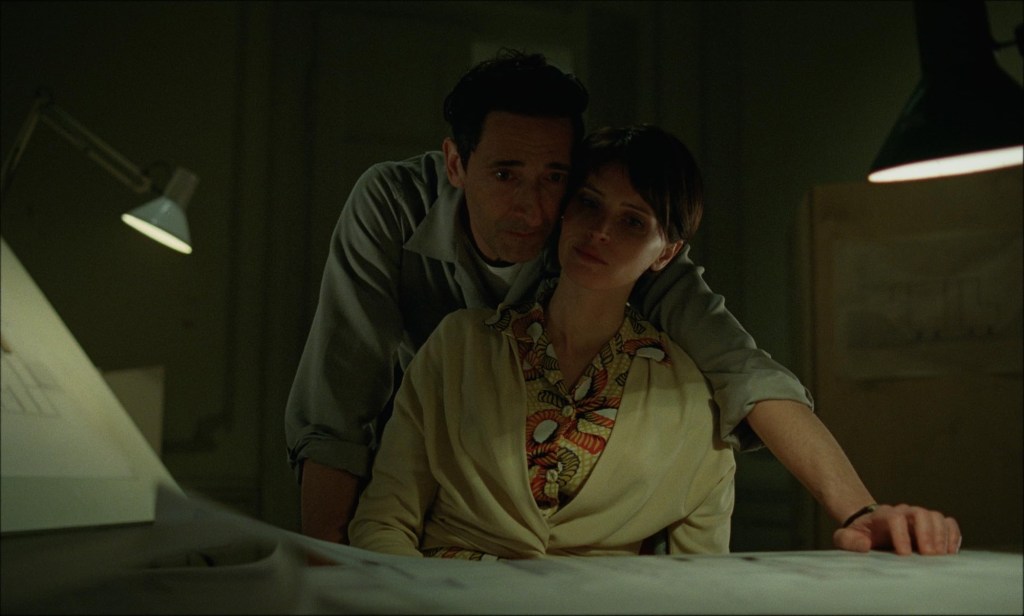
On a technical level, the film is flawless and should be experienced in theaters to fully appreciate it. Lol Crawley’s cinematography, shot on 70mm VisaVision, gives it a nostalgic quality that enhances the visual aesthetic. This allows viewers to understand every detail of the production design, particularly the effective use of lighting. It’s easily the second-best-looking film of the year, showcasing stunning locations from various countries, especially the haunting scenery outside the Carrara mines in Italy. And then you have Daniel Blumberg’s score that sends us into Laszlo’s world with a booming, blaring sound.
When you realize the runtime is three hours and 35 minutes, sitting in the theater for that long is daunting since it has a two-part structure, “The Enigma of Arrival” and “The Hard Core of Beauty,” with an epilogue. It was a slow burn but entirely engrossing from start to finish, even if the first half was stronger. Coming from someone who will typically complain about movies being too long these days, this didn’t feel that long, which is a significant credit to the acting to keep the interest intact. Fortunately, there was a 15-minute intermission build-in at about the hour-and-a-half mark, which surprised me to learn how quick the first half was. The only problem is that aside from a few scenes feeling slow, there’s something about the epilogue that does feel a bit out of place to have us interpret what it all means, making me a little surprised that it wrapped things up and probably didn’t give me the closure I wanted.
If the chance comes to watch this again, a good time window is required during the weekend, just like any other long film. With it already winning three Golden Globes (Best Motion Picture—Drama, Director for Corbet, and Actor in a Motion Picture—Drama for Brody) and recently receiving nine nods from the BAFTAs, now I can see how it might receive about ten nominations come Oscar nomination morning. Does this have a chance of taking home Best Picture at the Oscars? Part of me wouldn’t think the Academy would give it another three-hour drama in a row after Oppenheimer. But seeing how there’s no clear frontrunner this year, why not?
Overall, The Brutalist captures the immigrant American dream through an epic lens that’s impossible not to appreciate. Even when its lengthy runtime requires much patience, major props go to writer/director Brady Corbet for presenting an ambitious and intimate tale that delivers on all fronts. After just one viewing, it might not be one to be labeled a “masterpiece,” but it’s pretty close.

 DC's Take