
If anyone watched the 96th Academy Awards two years ago, it had to be the best time to be a massive fan of filmmaker Christopher Nolan. It was a moment to witness when Steven Spielberg announced him as the winner of Best Director for his three-hour-long biopic, Oppenheimer, and presented him with his long-overdue Oscar for Best Director and Best Picture. What a time to be alive, am I right? Right then, he became an unstoppable figure in Hollywood, drawing people to the theater for an unforgettable experience. Give him anything from traveling through space to making people interested in J. Robert Oppenheimer; this man knows cinema. The question on everyone’s mind had to be: What will his next project be for the next couple of years? Who would’ve imagined that his next anticipated film would be his adaptation of Homer’s epic fantasy poem? Nevertheless, no film of 2026 excited me more than The Odyssey when it was announced, because I can trust modern directors like Nolan to captivate us with a story unlike any other. Not that I had any doubts, it’ll be impressive if it’s only just good. But this proves, once again, that he’s a genius behind the camera, giving audiences the most immersive journey that can’t be topped. To put it short, it’s one of the best I’ve seen all year.
What’s the Story: After fighting in the Trojan War for ten years and successfully defeating Troy, Odysseus (Matt Damon), king of Ithaca, has faced the challenges of returning home. In his absence, suitors court his wife Penelope (Anne Hathaway), in the hope of one of them getting married and taking over the throne, with their son Telemachus (Tom Holland) believing his father is still alive after all this time.

When executed well, Greek mythology translates beautifully to film. The prospect of Christopher Nolan tackling this genre is enticing; his unique ability to craft grand spectacles could bring stories from three thousand years ago to life in ways we can only imagine. Learning earlier this year that he was originally slated to direct the 2004 film Troy—and an adaptation of its prequel, “The Iliad”—makes it clear that he needed to build his career before attempting such a sweeping tale of homecoming and hospitality. Ultimately, that shift was a blessing in disguise. I remember reading The Odyssey during ninth grade and recalling specific details, though the closest cinematic adaptation we had at the time was the Coen Brothers’ homage in O Brother, Where Art Thou?.
Because of how successful his last film was from a critical and commericala standpoint, only Universal Pictures can put their trust in Nolan to deliver on a big-budget ($250 million) adventure of Homer’s classic story because, aside from his previous film grossing over half a billion dollars, they know his vision of ancient Greece was something to behold, where other Swords and Sandals films over the last few years failed to capture. Despite its nearly three-hour runtime, the film is surprisingly well-paced thanks to editor Jennifer Lame, who maintains a sense of grounded realism throughout the journey. By focusing on the aftermath of the Trojan War, the story navigates a world filled with sirens, armored giants, and Poseidon’s wrath on the sea. While the introduction feels slightly rushed as it establishes the director’s signature non-linear narrative, the film finds its rhythm once it settles into its episodic structure. For those familiar with “The Odyssey”, the emotional weight placed on these characters is profound, often making me forget that these are the same mythological figures studied in high school, all while staying true to the core themes of homecoming and loyalty.
Expectations for his films are always high, particularly regarding the impressive ensemble casts that deliver committed performances regardless of role size. The spotlight here is on Matt Damon, who, following notable supporting turns in Interstellar and Oppenheimer, commands the screen as Odysseus. It is a bold choice for a period piece, yet Damon excels, capturing the character’s struggle, determination, and moral fortitude as he fights to return to his family. This physically demanding role is his finest work since The Martian and a strong contender for a Best Actor nomination.
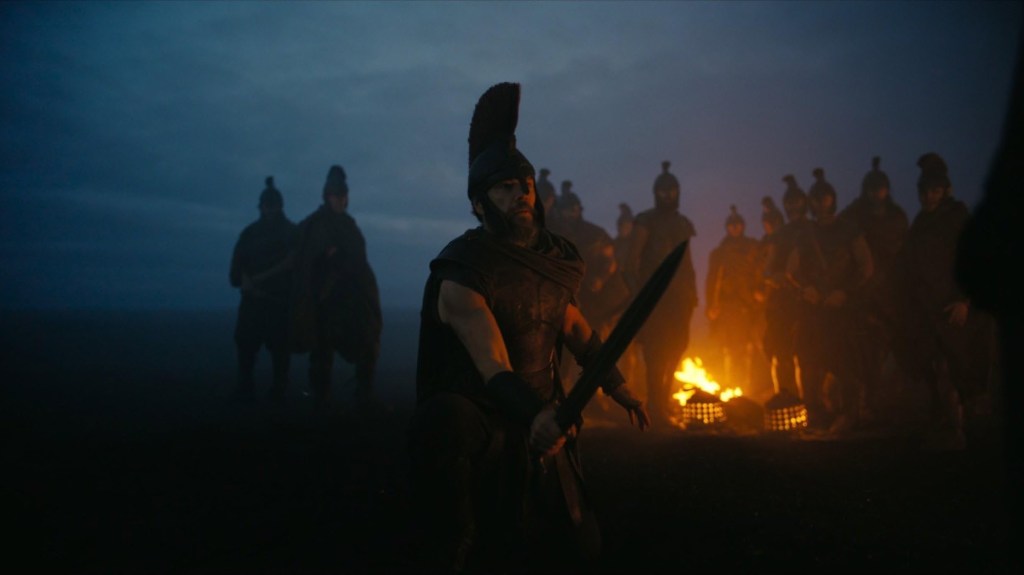
The rest of the cast delivers exceptional performances, with Tom Holland standing out as a neutral, inquisitive Telemachus—arguably his best work outside of playing Peter Parker/ Spider-Man in the MCU. As Odysseus’ son, he longs to know the father he never knew while traveling on his own to find the answers. Anne Hathaway, who’s continuing to have a stacked year, brings profound emotional depth to Penelope, portraying her weariness and unwavering hope amidst the suitors’ intrusion with grace, while Robert Pattinson proves his range as the truly detestable Antinous. Although the lack of period-accurate accents or archaic language was jarring at first, the choice to embrace a more modern tone ultimately works in the film’s favor. What an actor who gets better with each passing role. At first, it was strange knowing none of the characters were speaking with an accent or using almost-modern phrases in that time, especially when Holland, Pattinson, and Himesh Patel, as Odysseus’ second-in-command Eurylochus, are English actors, but it became natural after a while, and realizing it’s not that interested in being historically accurate to not be a massively distracting flaw against the film.
There’s also the likes of Charlize Theron as the nymph Calypso, who holds Odysseus captive by feeding him lotus flowers; Jon Bernthal as Menelaus; and John Leguizamo as Eumaeus, Odysseus’ visually impaired, trusted servant. The ensemble’s surprising standout is Samantha Morton as the witch Circe; her scenes on the island of Aeaea—along with the Cyclops sequence—represent the closest Nolan has come to directing horror. Given this star-studded cast, you won’t get many scenes of Zendaya as Athena, the goddess of wisdom, or Lupita Nyong’o in her dual roles as Helen of Troy and Clytemnestra. This highlight has reminded me of a recurring issue in Nolan’s scripts: they often underutilize female actors, even when Hathaway is afforded a more substantial role than the others. Speaking of which, the online backlash over the casting—specifically, Nyong’o or Elliot Page’s role as Sinon (not Achilles)—proves the racists and transphobics need to shut it. They probably had about five minutes of screentime. It is ridiculous for anyone to fixate on these casting choices in a film featuring a giant, one-eyed Cyclops. It is time for these detractors to stop complaining and simply experience the film for themselves.
Watching The Odyssey confirms that Nolan remains a master of practical, in-camera filmmaking, skillfully minimizing CGI and green screens. The result is overwhelming in the best way possible. As the first film shot entirely with IMAX cameras, it’s a technical marvel, especially considering the logistical challenges of handling such heavy equipment. While many will categorize this as a straight-up action film, the set pieces are perfectly balanced by deep, compelling drama. The tension leading up to the invasion of Troy was palpable, even after seeing the prologue twice. Throughout the final act, I found myself on the edge of my seat, deeply moved by the film’s meditation on loss and the psychological toll of war. It has been over a decade since one of his films almost brought me to tears—this marks his strongest third act since The Dark Knight Rises—a testament to how effectively Nolan makes us care for his characters.
But when you go to see The Odyssey, you expect a cinematic event, and it is no surprise that this film is grand in scale and visually breathtaking, successfully transporting the viewer to another world. Those who live near an IMAX theater presenting this in 70mm (especially if you live in Indianapolis) will be able to immerse themselves in every inch of the screen, enjoying Hoyte van Hoytema’s stunning cinematography in a format that maintains a consistent aspect ratio throughout. This is only the second film by Nolan that I have gone out of my way to see in this format, the first being Oppenheimer. Everything was captured in-camera, from the treacherous ocean voyages to the diverse locations in Ithaca, resulting in truly astounding visuals. Furthermore, following his Oscar win for Sinners, Ludwig Göransson’s third collaboration with Nolan offers something distinct; he creates a timeless soundscape using antique instruments that perfectly complement both the intimate character moments and the grand action sequences. While I wouldn’t rank this among Göransson’s absolute best on a first watch—as the incredible sound mix design (an improvement over his last two efforts) is more understated than his previous work—it still features several pieces that are genuinely goosebump-inducing.
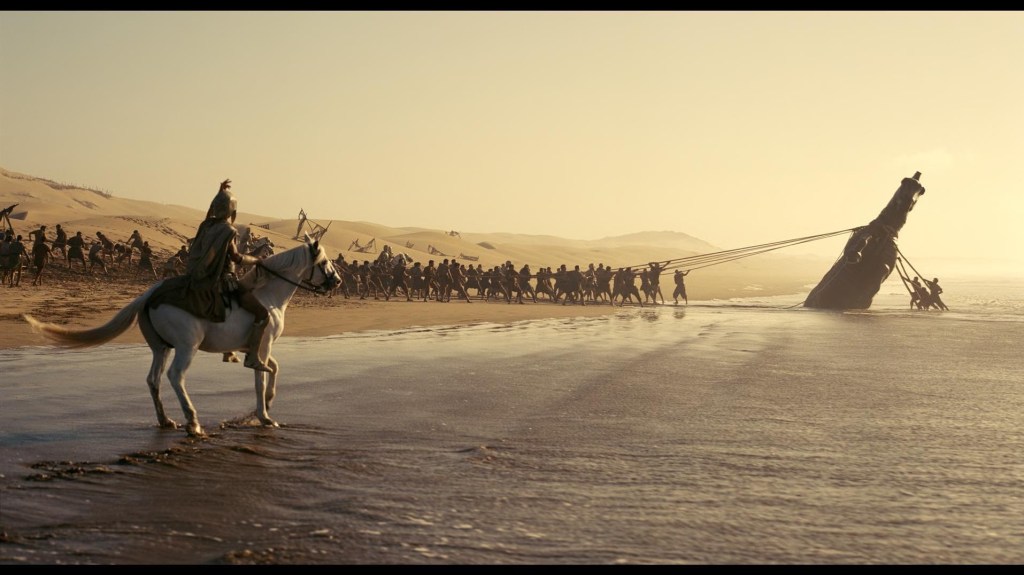
I haven’t had too many trips to the movies this year, as there was hope this had the chance to bring the momentum in films I’ve and probably everyone else has been missing in our entertainment. After not reviewing anything since late April, this was what I needed. The Odyssey is the blockbuster that the summer box office desperately craved. Because you think back to the franchises or familiar IPs that performed poorly (The Mandalorian & Grogu, Supergirl, Moana, etc.), and since Nolan is one of those filmmakers who gets audiences to sell out multiple showtimes on opening night alone, it’s a guaranteed hit that’s going to have everyone seeking it out more than once. Anyone who walks out of this and does not feel a thing, why should I trust your opinion? For me, we’re looking at an early Best Picture contender until anything else scheduled to come out this year will match it from a blockbuster perspective.
Overall, The Odyssey has Christopher Nolan delivering the Ancient Greek epic that’s unsurprisingly amazing from start to finish. It’s a translation that could’ve been dry in the wrong hands, but with a filmmaker eager to take this story forward with versatility and passion, the results are stunning in more ways than one. If he’d been waiting for over two decades to bring Homer’s story to life, he accomplished something remarkable.


