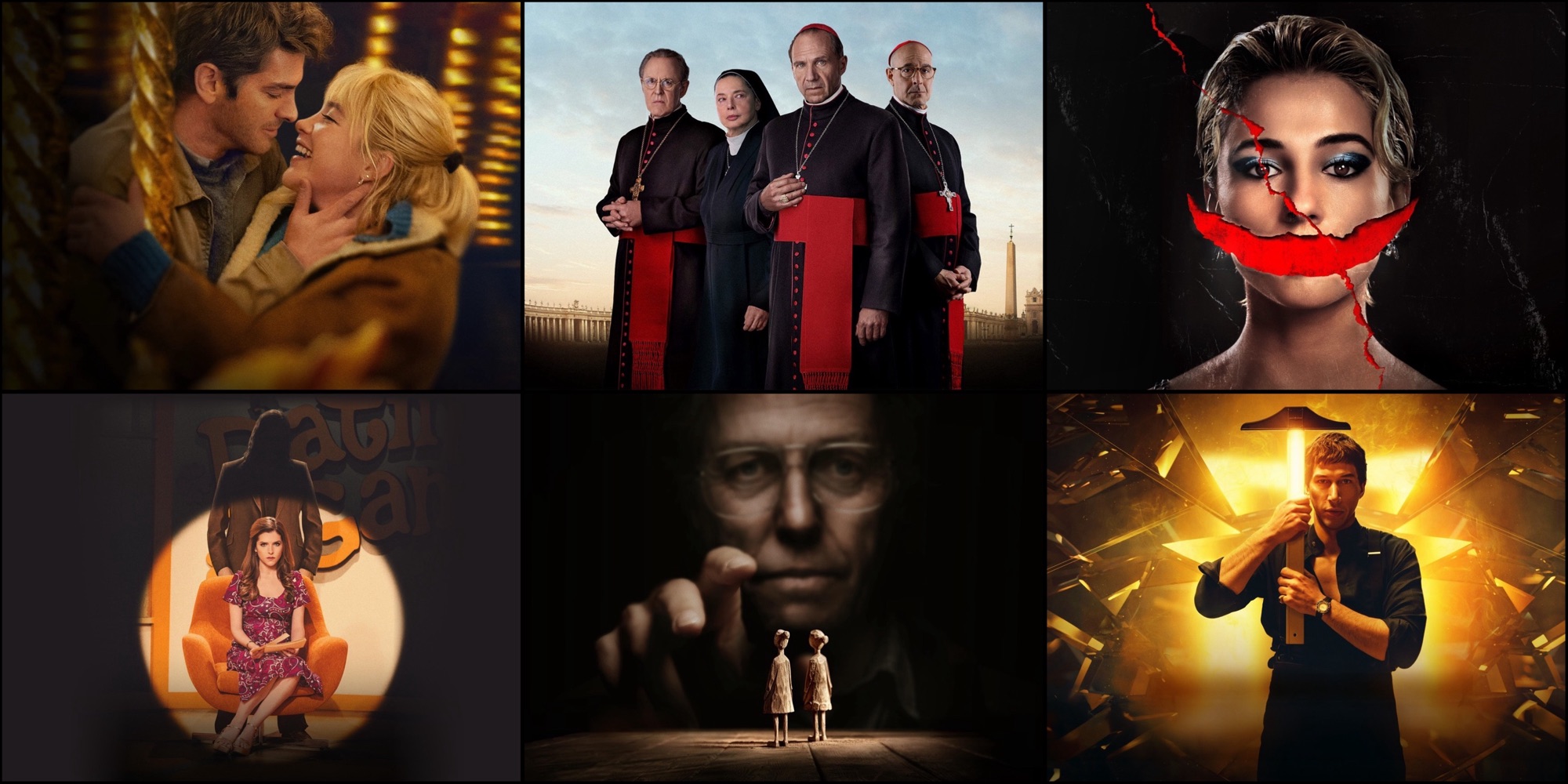
December is always a time to catch up on the movies I missed in theaters during the fall and enjoy them at home. Although I watched several films, like The Crow and Red One, that I didn’t feel were worth discussing, there are six movies I recommend and one that I suggest avoiding. Let’s talk about my thoughts on We Live in Time (the only film I saw in theaters in October), Smile 2, Heretic, Conclave, Woman of the Hour, and Megalopolis.
We Live in Time
The universe asked for a romantic drama with Andrew Garfield and Florence Pugh, and it was received with the A24 joint We Live in Time. Those two names alone were enough to leave me interested when this film came about. And it’s one I tried to know almost very little about, only feeling like it had the potential to be a real tear-jerker. While it may not reach the level of (500) Days of Summer, in my view, director John Crowley not only redeems himself after the disappointment of The Goldfinch, but also allows the story to unfold in a surprisingly authentic way.
What’s the Story: Bavarian fusion chef Almut Brahl (Pugh) and Weetabix representative Tobias Durand (Garfield) meet in an unusual way. While out buying pens to sign his divorce papers, Almut accidentally runs him over and stays with him at the hospital until he wakes up. Over the next ten years, their relationship experiences both highs and lows, from the joys of being parents to their lovely daughter to the heartbreak of Almut’s ovarian cancer diagnosis, which is too advanced to be surgically removed.

Not that I went into We Live in Time expecting this life-changing experience, but what will be effective for its audience is understanding how the value of time is vital to us all. No relationship we have with our romantic partners is predictable, but it can feel like all the time in the world when you connect strongly with each other. The film’s structure uses non-linear storytelling, which doesn’t start immediately with how Almut and Tobias meet. We learn very early on about her diagnosed illness. Admittedly, it started a little disjointed in trying to keep up where we are. It was a problem in the back of my mind, but jumping around, in retrospect, makes sense so it’ll be easier to digest what’ll happen later if things go wrong.
But what made this appeal to me the most while watching was how perfect Pugh and Garfield were together. You have two of the best English actors working today, and it’s an on-screen pairing so effortlessly charming to see grow throughout the runtime. They honestly made Almut and Tobias so low-key with their love for one another through its naturalistic dialogue, where it’s like peaking into the day-to-day life of real-life partners. They have this authentic dedication to cherishing the time they have to make one happy, especially when Tobias wants her to be as healthy as possible. Both are fantastic in keeping you invested in their journey, proving they’re actors I’ve looked up to since their breakout years. You have a scene where she’s giving birth inside the bathroom of a convenience store, and it’s made out to be funny and touching simultaneously. One of the most memorable childbirth scenes in recent memory?
Even if the plot isn’t the most original, it’s easy to overlook a few genre conventions. I was surprised that it didn’t make me tear up at any point. While nothing brought me to tears, I still felt a connection to what the characters were experiencing. This connection made me wish for an emotional impact in the ending, which unfortunately didn’t come. Although Nick Payne’s script isn’t likely to receive any awards, everything else contributes to a solid melodramatic experience I could enjoy again.
We Live in Time explores themes of love and human connection through an ambitious narrative that may not resonate with everyone. However, it ultimately comes together and proves worthwhile thanks to standout performances from Andrew Garfield and Florence Pugh.
Grade: B
Smile 2
After Paramount realized how successful the first Smile was at the box office ($100 million domestic), it made sense to give it a sequel that could also give us nightmares. I’m curious to see what writer-director Parker Finn will come up with in Smile 2, especially since I found his 2022 directorial debut to be an okay horror film that I still need to rewatch. Creating a sequel can be challenging, especially when the original was an unexpected sleeper hit in the genre. Although I didn’t think Finn aimed to make one of the greatest horror movies of the year, he still delivered an exceptionally effective and arguably better sequel.
What’s the Story: Pop star Skye Riley (Naomi Scott) is about to prepare for a comeback world tour after suffering from troubling substance abuse and a car crash that killed her boyfriend. With pain from her back still hurting and needing some Vicodin, her quick trip to buy from her drug dealer, Lewis (Lukas Gage), turns into chaos. Panicking and screaming inside his apartment, he gives Skye a sinister smile before smashing his face with a barbell plate to his death. In shock at what she witnessed in front of her, Skye is the next person beginning to see people smiling at her, taking her paranoia to a whole new level.

Finn brings back the same tension and scares that fans of the first installment enjoyed. This sequel’s focus on a celebrity makes it an improvement, which allows for a more creative narrative as she becomes the next victim. The story’s setup is similar to the original, but the unfolding events create a sense of dread regarding Skye’s fate, exploring how trauma and mental health impact one’s mind. With a strong opening that connects to the first film’s ending, it doesn’t disappoint, featuring unpredictable jump scares and excellent sound design that enhances each moment.
Naomi Scott wholly owns the movie, much like Sosie Bacon’s role in the original. This was the performance I’ve been waiting for people to talk about after underwhelming blockbusters like Aladdin and Charlie’s Angeles didn’t utilize her well, and channeling this pop star that’s a combination of Lady Gaga and Dua Lipa, you ultimately care for Skye’s well being. With her return to the spotlight, Scott’s Skye is pressured to make her tour a massive success. However, her life was disrupted by this entity, leading everyone to believe she was going insane again. Or replased. Scott’s performance, reminiscent of Sarah Michelle Gellar, was marked by the fear in her eyes that made her feel unsafe. The impact of the disbelief of those around her added a psychological horror aspect, making it one of the most memorable horror performances of the year.
This sequel effectively expands Finn’s lore and doesn’t shy away from graphic imagery infused with camp that makes it difficult to look away from the screen. The anxiety that Skye experiences parallels our feelings as we navigate through a mental breakdown while playing with our minds. At times, the pacing may feel slow, and the ending can unexpectedly subvert your expectations, leading to questions about the true extent of what this demon can do to induce overwhelming madness. Overall, as far as horror sequels go, this film successfully builds on the existing universe, leaving fans eager to see what comes next.
Smile 2 surprised me even more than its predecessor. Parker Finn has managed to raise the bar, thanks to a fantastic leading performance by Naomi Scott and memorable scares that linger in your mind long after the film ends. While I wouldn’t say this is on a fantastic scale, I am left wondering about the future direction of this franchise.
Grade: B
Heretic
If I had to take away anything from watching Heretic, it would be the relief of not being raised by Mormons and the realization that it might take me a while before I can enjoy blueberry pie again. In all seriousness, I didn’t know what to expect from A24’s latest psychological thriller. Would it challenge my thinking, or would I be confused by how its characters mock religion? What writer-directors Scott Beck and Bryan Woods delivered was a pleasantly riveting cat-and-mouse game that turned out to be smarter than I initially thought.
What’s the Story: Two young missionaries, Sister Barnes (Sophie Thacher) and Sister Paxon (Chloe East), are part of the Church of Jesus Christ of Latter-day Saints to spread the word about their Morman faith. Their door-to-door pitch to end the day is with Mr. Reed (Hugh Grant), who invites them into his Colorado mountain house to tell him information about the church and have a slice of his wife’s pie. The topic of Mormonism goes in different directions, leading to Barnes and Paxton feeling a bit uncomfortable. However, with the front door locked and no phone signal, Mr. Reed tests the two by letting them discover what they truly believe in, which might take more than a conversation to get him through.
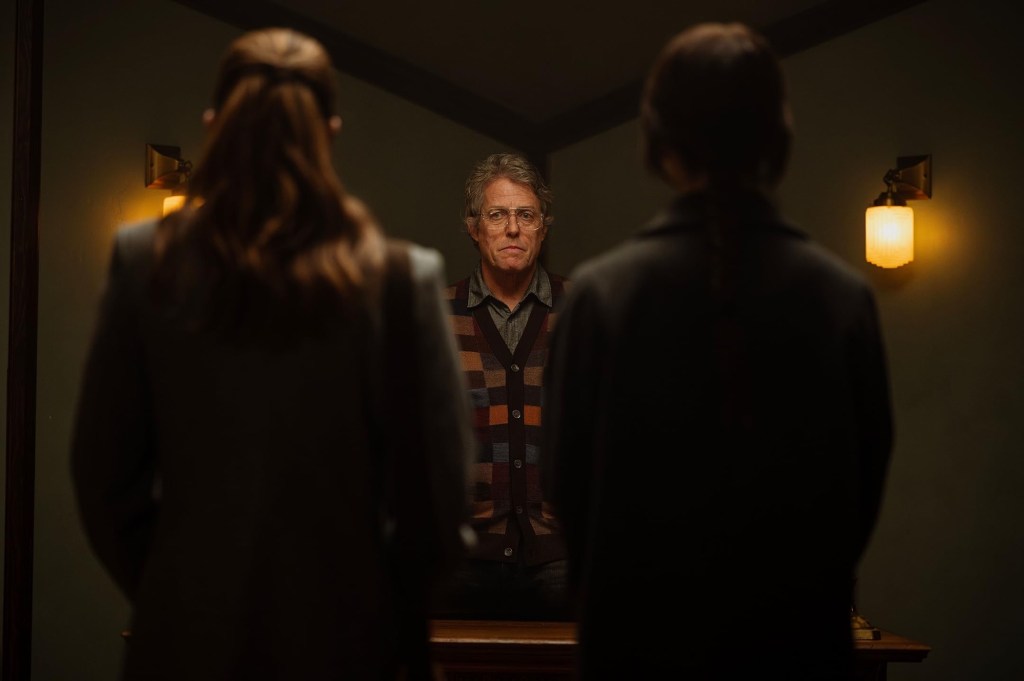
With Beck and Woods’ previous film left more to be desired, the sci-fi thriller 65, my prayers for them to make anything better came proper a year later in how it builds suspense like no other. Part of me thought Heretic would be a straight-up horror or the kind that would come from the company, but it’s very much on a psychological level, with maybe one or two scares that nearly got me. As we enter Mr. Reed’s home, it initially appears calm, reflecting his fascination with the topic that Barnes and Paxton came to discuss. However, early signs of tension are present, suggesting that leaving may not be straightforward. Much like the script for A Quiet Place effectively explores the theme of silence, this situation raises several philosophical questions related to various religions, which could resonate deeply in specific discussions.
Heretic is one of the most dialogue-driven thrillers in recent times; it’s never dull, especially in the first half, where the setting feels like a character in its own right. The conversations between the three characters are captivating as they delve into a subject that isn’t easy for everyone to discuss, often leading to heated arguments. This screenplay avoids being preachy or boring, and it does not take a side in the debate. Our two protagonists are part of a challenge that has them believing in one thing or not. Mr. Reed has two doors with “belief” and “disbelief” written on them. When it quietly builds that tension through unpredictable turns, its dark humor comes when it offers clever metaphors in how religion is all one “iteration,” from Monopoly to how “Creep” by Radiohead plagiarized “The Air That I Breathe” by The Hollies.
Hugh Grant’s performance in this role may be his best yet. At this point in his career, where he’s portraying villains, he surpasses my expectations by making Mr. Reed both charming and terrifyingly clever. He’s reminiscent of Kathy Bates in Misery, as he is willing to delve deep into his character to reveal the ultimate truth to his guest. Trusting him becomes a game in itself. And to think he didn’t care about the roles he chose. But both Sophie Thatcher and Chloe East were superb as these missionaries who might be naive with their background but don’t make dumb decisions even when hiding their fear in this situation with their different personalities. Thatcher, in particular, has slowly begun making a name for herself in the genre.
This film was almost in my top 10 of the year. The only downside was that the last 20 minutes didn’t quite deliver as expected. While it wasn’t bad, it included some explanations that, without spoiling anything, didn’t initially make sense. However, it concluded with a final scene I had predicted early on, which was still quite compelling.
Heretic stands out as one of the most intelligent thrillers in recent memory, thanks to its memorable performances by the three leads and its exploration of complex themes, all wrapped in just the right amount of psychological tension. It’s unfortunate that I missed the chance to see it in theaters, but a film this thought-provoking, paired with such an impressive atmosphere, is definitely worth remembering.
Grade: A-
Conclave
Although the subject matter may not be my preferred topic and I often lack interest when it appears in the news, it seems that everything surrounding Conclave has the potential to become a captivating thriller worth discussing during this awards season. More importantly, this sees director Edward Berger’s anticipated movie after his 2022 remake of All Quiet on the Western Front, which was an unexpected hit and is still on my watchlist, won four Academy Awards and seven BAFTAs. Luckily, his adaptation of Robert Harris’ best-selling 2016 novel of the same name quietly proves he’s a filmmaker who can task anything with a drama that sneaks up on you with its engrossment.
What’s the Story: With the recent passing of the Pope after a heart attack, Cardinals from around the world gathered together in secret to cast their vote and decide who would be chosen as the new Pope. Under the leadership of Cardinal Dean Thomas Lawerence (Ralph Fiennes), Dean of the College of Cardinals, this Conclave has different candidates running for this position, from American liberal Aldo Bellini (Stanely Tucci) to Italian traditionalist Goffredo Tedesco (Sergio Castellitto), where Lawrence finds himself in the middle of a conspiracy that’s lurking behind closed doors of the Vatican itself.

On paper, Conclave could’ve been another very dialogue-heavy film that’ll come across as preachy since it deals with religious facts, aiming to tear one down to the next. And while it wasn’t a surprise this doesn’t lean into action, it still captivates your attention through these three days of this conclave. The film’s first half has a slow-burn quality, which may confuse some viewers if they are not familiar with the underlying belief system. However, credit goes to Berger’s direction and Peter Straughan’s screenplay (Tinker Tailor Soldier Spy) for providing insight into what appears to be a daunting process when a new pope is chosen. This narrative also mirrors our presidential elections, particularly capturing the frustration that looms over America for the next four years. With any election, anybody wanting to gain power and responsibility might hold back secrets on the inside while fighting for what’s right for the church’s representation. It’s when the film progresses and becomes more palpable when it favors twists and turns that kept me compelled till the end.
Ralph Fiennes is undoubtedly one of our greatest actors, and his performance as Cardinal-Dean Lawrence may be his best in years. In this subdued role, he skillfully portrays a man grappling with responsibility as he selects the perfect candidate while questioning his faith. It’s as if he sees himself as the pope, scrutinizing others accused of sin. Fiennes adds depth to his character, revealing complex layers as he engages with those around him and responds to the information he uncovers. Not as showy as I thought, but it proves he’s a talent worthy of a Best Actor nomination. Stanley Tucci is another standout with his Cardinal Billini, which might not be as truthful as he may appear, matched with an intriguing dynamic with Fiennes in their scenes together. And though there wasn’t as much John Lithgow and Isabella Rossellini as I expected, they completed this cast with their turning roles.
The plot can sometimes feel overly complicated, particularly during the third act, which I found somewhat confusing. While this didn’t ruin my overall experience, there was a surprising revelation that might not sit well with everyone. It might’ve come straight from the novel, and the story concludes abruptly. Besides that and the slow first half, now I can see why Conclave is meant to be an Oscar contender. You have a fascinating story topped with some of the best cinematography work of the year from Stéphane Fontaine and a suspenseful score by Volker Bertelmann.
Exploring the realm of politics can be quite challenging, as it may change the overall tone. However, Conclave is an effective thriller for an adult audience. Edward Berger skillfully navigates the complex environment of the Vatican, and Ralph Fiennes delivers a memorable performance.
Grade: B+
Woman of the Hour
When I heard that Anna Kendrick was stepping into the director’s chair for her first feature, my excitement skyrocketed. Thriving since she broke out in her Oscar-nominated role in Up in the Air, Kendrick has consistently impressed audiences across various genres. With her infectious personality and charisma, it’s no wonder she was a major celebrity crush of mine during my late teens. Her film Woman of the Hour, which premiered at TIFF before being picked up by Netflix, showcases her potential as a filmmaker, demonstrating her skill in crafting a compelling true crime narrative that feels incredibly authentic.
What’s the Story: In the late 1970s, Sheryl Bradshaw (Kendrick) was a struggling actress debating leaving Los Angeles for a better-suited career. But as luck would have it, her agent tells her she will be a contestant on an episode of The Dating Game, which lets her meet a great guy and helps boost her career. With the show’s premise of the female contestant asking her three unknown bachelors innuendo-like questions for the chance to go on a vacation, little does Sheryl or anyone know one of them, Rodney Alcala (Daniel Zovatto), is a serial killer traveling across the country with nobody able to catch him.
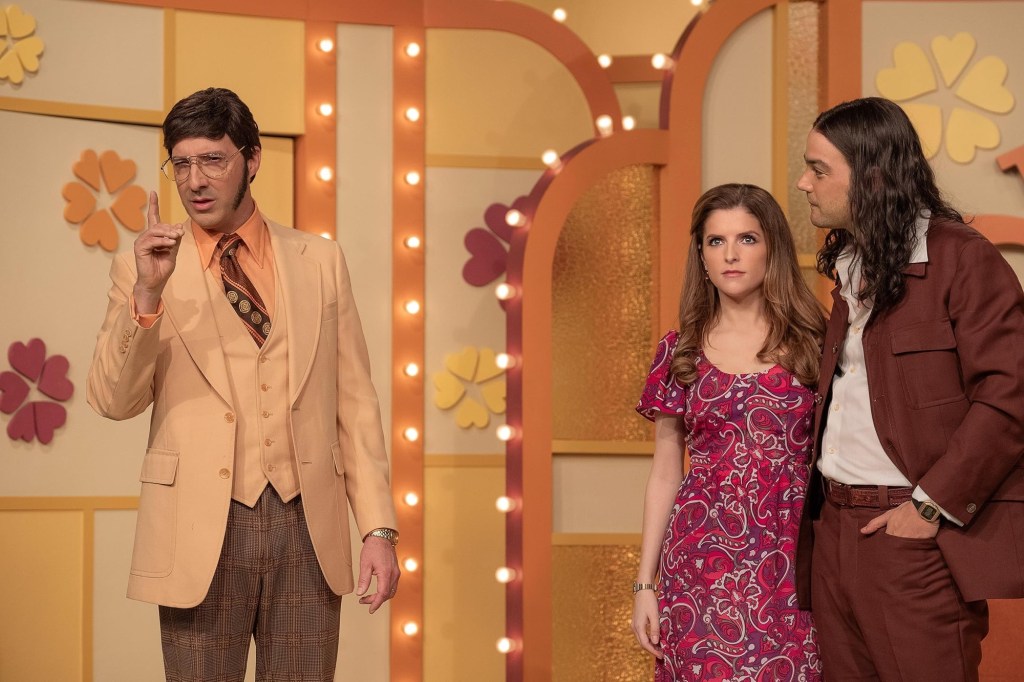
Despite its age, this story remains striking and memorable. I recall reading or watching it years ago, finding its premise hard to believe. In an era when game show controversies were a growing problem—like the rigging of Twenty-One, portrayed in Robert Redford’s Quiz Show—this tale is even more chilling. A man is on a murder spree, using his charm and the camera to lure young women. I expected the narrative to unfold chronologically, but instead, it weaves back and forth through Rodney’s encounters. The police continually fail to capture him as he desperately tries to win Sheryl’s heart with his deceptive responses, creating an unsettling and gripping experience. But unlike other serial killer movies that show graphic kills, it goes with a nuance vibe that has us imagine something worse than what really happened.
Kendrick must’ve been terrified stepping behind the camera to tell a dark story, but her confidence is shown through her direction and performance, proving her versatility. Working from a script from Ian MacAllister that’s been on the blacklist of unproduced screenplays, she is able to infuse a nice amount of tension and almost dark humor that speaks out about the violence towards women, especially during the decade. Kendrick quickly reveals this man’s demons in the opening scene, letting us know what kind of unsettling character he is as he takes his seat on stage. Even when directing herself, it’s no surprise that she brings her characteristic snark, demonstrating her intelligence as the smartest contestant without playing to the cameras. This role is easily one of her best performances since Alice, Darling.
And Zovatto perfectly portrays this disbursing guy, dubbed “The Dating Game Killer,” where you can’t tell what’s hiding behind his eyes. Just the first date Alcala and Sheryl go on is filled with the kind of awkward tension one would expect that has her seeing red flags all around him. This also has a breakout role for Autumn Best as a young runaway named Amy who meets Rodney to think she has a career as a model and Nicolette Robinson as a woman who knows who he is when attending the show’s taping. Her storyline felt a tad unreal to be a subplot, but that’s probably the film’s only problem in an otherwise well-paced drama.
Woman of the Hour showcases Anna Kendrick as an impressive director, presenting a captivating story that leaves a lasting impression. While it is fascinating, it also becomes disturbing when you learn what happened afterward. This film marks a promising beginning for a different aspect of Kendrick’s career.
Grade: B+
Megalopolis
Almost everyone who watches Megalopolis will likely ask the same question: “What happened to Francis Ford Coppola?” This Academy Award-winning filmmaker is known for creating timeless classics such as The Godfather trilogy, Apocalypse Now, The Conversation, and Bram Stoker’s Dracula. However, he hasn’t directed a film in over a decade, leaving us curious about what he has in store that we will remember. Ultimately, we realized that Coppola had wanted to do a long-time passion project for the last 40 years, and its production budget of about $120 million was funded by selling half his winery and partnering with Lionsgate for distribution. Everything about Megalopolis was poised to be the year’s most polarizing film after the reaction from the Cannes Film Festival and the trailers failing to sell the anticipation. If you ask me, this epic sci-fi fable isn’t the worst thing in the world, but it’s what I can certainly call an ambitious, embarrassing mess.
What’s the Story: Set in the alternate modern American city of New Rome, visionary architect Cesar Catilina (Adam Driver) aims to transform the city into a utopian society using his revolutionary building material, Megalon, for which he won a Nobel Prize. However, his conflict with conservative Mayor Franklyn Cicero (Giancarlo Esposito), who plans to tear down much of the city, creates tension regarding their visions for its future. Meanwhile, Cesar is involved in a romance with Cicero’s daughter, Julia (Nathalie Emmanuel), and he must also contend with his cousin Clodio Pulcher (Shia LaBeouf), who desires power and conspires to incite an uprising against him.

Coppola has never undertaken a project of this scale to convey his themes. However, despite his efforts to address issues for a better future and the allegories connecting New Rome to contemporary American society, those who call this film a misunderstood masterpiece destined for a cult following should be viewed with skepticism. Sitting through the two-hour and eighteen-minute runtime was challenging due to an incoherent narrative, which made the story feel hollow and overly ambitious. Bright ideas quickly got lost amid poor CGI and green screen effects, alongside decent yet flat cinematography from Mihai Mălaimare Jr. Coppola’s screenplay managed the rare feat of being both confusing and pretentious, presenting the dialogue that aspires to be clever but ultimately falls short. It would have been interesting to see a character like Cesar use his abilities to change the world and help those in need, while Cicero is driven by greed. However, the story doesn’t clarify who is truly in the right by the end. Additionally, it fails to explain why Cesar possesses the power to stop time, as it is included purely for visual appeal.
It’s disappointing to see a large ensemble cast that lacks strong material to work with. Many actors adopt different styles of acting that don’t always align with the overall tone. Adam Driver performs well within his role, even though he doesn’t seem to sympathize with his character, Cesar. While I appreciate Nathalie Emmanuel as an actress, her performance feels overly serious, and the romantic connection between her character and Driver is nonexistent. There are good actors like Aubrey Plaza, Esposito, Laurence Fishburne, Talia Shire, and her son Jason Schwartzman. However, I also find actors that audiences don’t like, from annoying Shia LaBeouf, Jon Voight, and Dustin Hoffman. None of their characters have any real significance in the film. You definitely wouldn’t want to watch a movie where Plaza’s performance as Wow Platinum (yes, that’s the name) is over-the-top—not in a good way—in her delivery. Along with LaBeouf and Voight, her portrayal feels the most cartoonish, especially during a scene that features all three of them and a crossbow later on.
Even if it’s meant to be some political commentary he imagined in his head, it still came across as overly consulted. There’s this 20-minute sequence at Madison Square Garden that has to do with chariot races, Grace VanderWaal as a pop star selling her virginity to the highest bidder, and it all felt like a bad acid trip that had me knowing it wasn’t going to get better. There’s just too much happening. A small part of me genuinely hoped that Megalopolis would turn out to be a good film. However, as we’ve seen with other filmmakers taking bold risks, like Ari Aster with Beau is Afraid, Richard Kelly with Southland Tales, or even Oliver Stone with Alexander, these ambitious projects often end up being disappointing. Everything comes ahead to the realm of nothing whenever it tries to develop any personality and brings no momentum. The amount of investment Coppola puts into this story is all overstuffed to feel nothing when it’s over.
Some may think this film is excellent, as fans of the director will appreciate the effort he put into bringing his vision to life. Even some of the best directors experience a few misses later in their careers, and this film is a prime example of failure. If this is indeed his last film, given that he is 85, it’s a sad conclusion to his career. To no one’s shock, it’s the biggest box office bomb of 2024. While I don’t admire the execution of his idea, it was an expensive gamble that many realized wouldn’t succeed, making it a likely contender for the Razzies.
Overall, Megalopolis showcases Francis Ford Coppola’s ambitious attempt to tackle grand themes but ultimately falls short in its execution. The film struggles with an overwhelming number of characters and a narrative that lacks interest and coherence. With these issues combined, it is difficult to find anything admirable in what is undoubtedly one of the year’s worst films.

 DC's Take