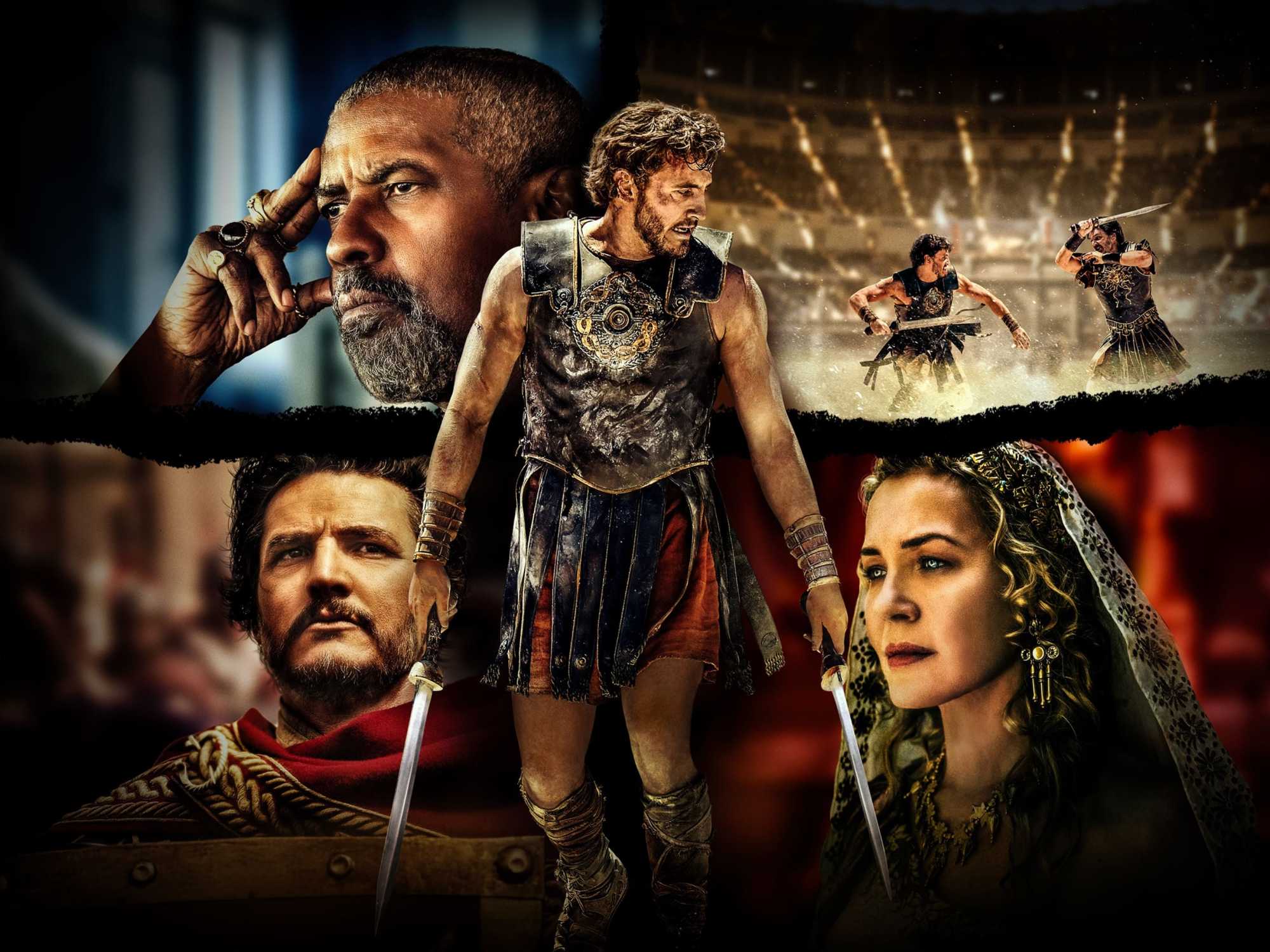
No matter how messy Ridley Scott’s filmography may appear, you can’t deny the bastard will do almost anything to show audiences what he’s still capable of. Does he give two craps about length? Nope, but in his mid to late ‘80s, he doesn’t show signs of slowing down. Though the filmmaker churned out classics like Alien, Thelma & Louise, and The Martian over the decades, everyone will agree one of his very best in the last twenty-four years is the original Gladiator. Marking a triumphant return to the swords and sandals subgenre, the film weaves an epic tale of a Roman general’s journey from slave to gladiator, a testament to the power of redemption. Its five Academy Awards, including the prestigious Best Picture, a rare achievement for a summer blockbuster, is a testament to its cinematic brilliance. While it may not be an all-time favorite for me, it’s a film that never fails to impress.
So, when Gladiator II was finally announced after years of speculated rumors about the story, it still left me nervous since the first was so iconic that it couldn’t be replicated. While it wasn’t one of my most anticipated films of the fall since the first is a historical classic, part of me didn’t want to walk out of the theater thinking to myself, “What was the point of making the same movie over again?” This legacy sequel might not match the same level of greatness as its predecessor, but it’s safe to say Scott let us know we’ll be entertained once more and give it the thumbs up.
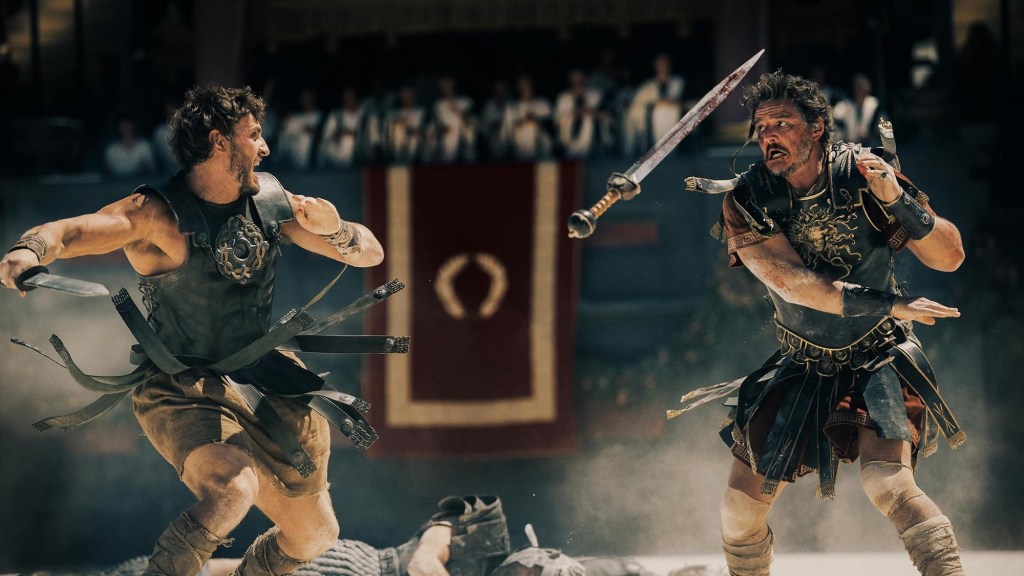
What’s the Story: Sixteen years have passed since Maximus Decimus Meridius died inside the Colosseum, and Rome is ruled by tyrannical twin emperors Geta and Caracalla (Joseph Quinn and Fred Hechinger). The heir to the Roman Empire, Lucius (Paul Mescal), who is going by Hanno, lives in the North African province of Numidia with his wife. His life takes a devastating turn after General Marcus Acacius (Pedro Pascal) and his army invade the city, killing his wife in the battle and leaving him to be captured and sold into slavery. Lucius’ fate for survival leads him to the Colosseum, where he catches the eye of the master of gladiators, Macrinus (Denzel Washington). Under Macrinus’s guidance, Lucius is forced to fight for his freedom and revenge against General Marcus Acacius.
Sequels to Best Picture winners are rare in Hollywood because anything to top its predecessor would have to be challenging. A few succeeded with The Godfather Part II and the Rocky franchise. In contrast, others failed to meet those expectations, such as the forgotten Terms of Endearment sequel The Evening Star or Hannibal (which Scott also directed). But for a sequel to one of his own, it was a surprise to see Scott in his element to capture the same excitement we’ve come to like before. The energy that must’ve been lacking from his other historical epics that’s not the first Gladiator or the underrated The Last Duel felt like he was trying to recapture his prime by building up the scope of the era through violence and a deep dedication to the craft. This brings us back into this world, to where it came across as a follow-up that fits closely with before.
Mescal has slowly become one of those actors about the same age I’m anticipating seeing in anything. His career has grown after getting recognized for his work in All of Us Strangers and his Oscar-nominated performance in Aftersun; his leap into a leading man in blockbusters is in full swing. At first, I struggled because Spencer Treat Clark wasn’t reprising his role. However, this concern was short-lived. The actor’s physical prowess and ability to excel in action scenes quickly won me over. His performance is so powerful that it’s unfair to compare his character growth to Russell Crowe’s, as they each have a distinct journey. Maybe Lucius doesn’t carry the same amount of gravitas that Crowe brought to his Oscar-winning role, but he still brings rage to his battles. He is given more of an emotional core that’s unexpected in having another man nobody had faith in becoming this lone hope for Rome to retain its glory. Something tells me this will make him a household name.
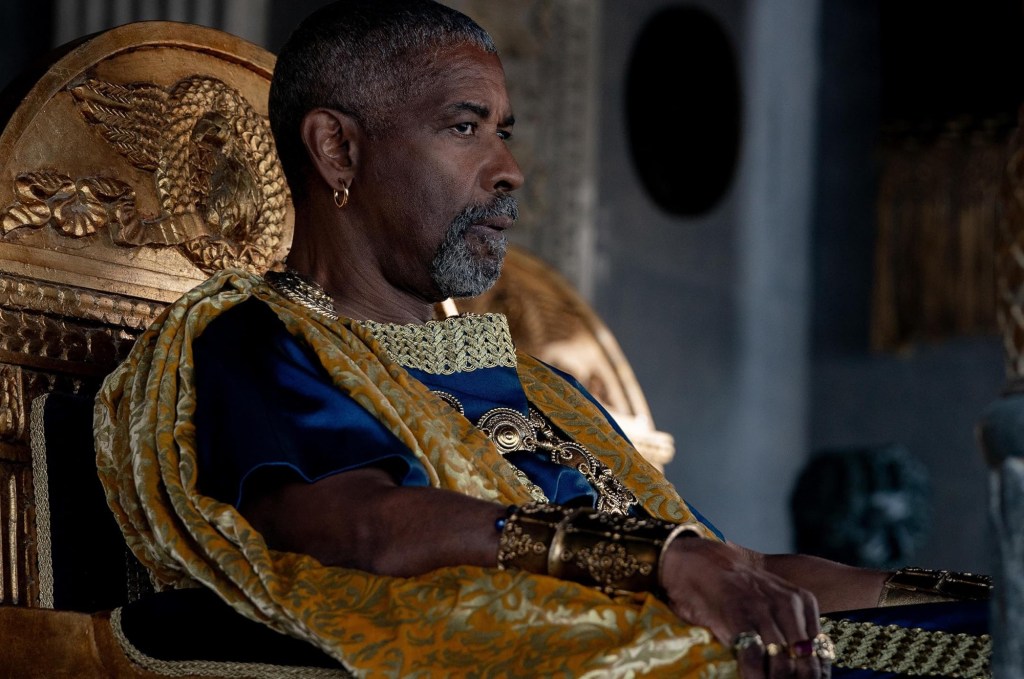
But the minute Washington came on-screen as the former enslaved Macrinus, I had a big grin since he knows how to bring so much charisma to his roles. He’s been in the business for decades, where he will be the best part of a film that’s not even great. Give me a performance of him perfectly chewing the scenery while making his character seem charismatic, and it becomes a standout without question. Washington was able to feel like a calculating man on the inside without assuming he was playing himself or an ancient version of Alonzo Harris. He made us think complexly about Macrinus, siding with someone first and the others later on through his manipulation of power. As of right now, he’ll possibly receive a nomination for Best Supporting Actor. A shot at winning? Who knows? Pascal’s Acacius always provides much-needed screen presence. There’s not as much of him as I wanted, but he was given more depth than I wasn’t expecting. To him, there’s this clear sign as to why Lucius has vengeance against him, but we soon learn he’s a nobleman tired of fighting the twins’ war and board to trying to dethrone them for good.
What Scott does best, even when the films themselves are less than stellar, is delivering memorable set pieces, and the ones in Gladiator II are no different. Especially when it’s experienced in IMAX, the battles in the Colosseum come to life, making you feel like you’re right there, witnessing these men fight for their lives and freedom with swords, blood, and fists through a visceral blend. Consider this: a colossal rhino, naval ships, and sharks all in one arena (not all at once), with Lucius demonstrating his leadership to his fellow gladiators. This may not align with historical accuracy, but it sparks imagination. The more I pondered this spectacle, the more I questioned the logistics of how those sharks ended up inside the arena. Also, one of the only times the visual effects didn’t look good was with the baboons. The technical side perfectly captures the time through its production design, costume design, and John Mathieson’s return as cinematographer.
Even though this wasn’t a complete carbon copy of the first, you can’t help but notice David Scarpa and Peter Craig’s screenplay have some familiarity with the story. Although I knew where everything was going, the first half favored me, loving it early on. Things started to pick up afterward, and that’s when it began to focus on its path. The comparisons are there, especially if you’re like me and rewatched the original days prior. But I did enjoy how Rome hasn’t changed through its politics and corruption, feeling like how we view today’s political climate based on our president-elect in how this wasn’t the dream Marcus Aurelius wanted. Funny enough, what’s his face is more evil than our antagonists. And this is one of the rare times when it was well-paced for a Scott film, considering it’s close to two and a half hours of runtime. 2024 has seen its fair share of sequels that might leave more to be desired. But as someone who didn’t care for either House of Gucci or last year’s Napoleon and didn’t think highly of the trailers, I found this recent film of his mildly necessary. And it’s compared nicely to what came before. As for its Oscar chances, it’s a strong contender for a few nominations in the technical categories, though it’s unlikely to get in Best Picture or Director.
Overall, Gladiator II is an entertaining legacy sequel that Ridley Scott has crafted to transport audiences back into this enthralling period without detracting from our prior enjoyment. While many may still hold the original in higher regard, and I personally find it to be better, this is a commendable addition to the franchise. It may not be the sequel everyone was clamoring for, but it’s undeniably one of Scott’s stronger films in recent years.

 DC's Take