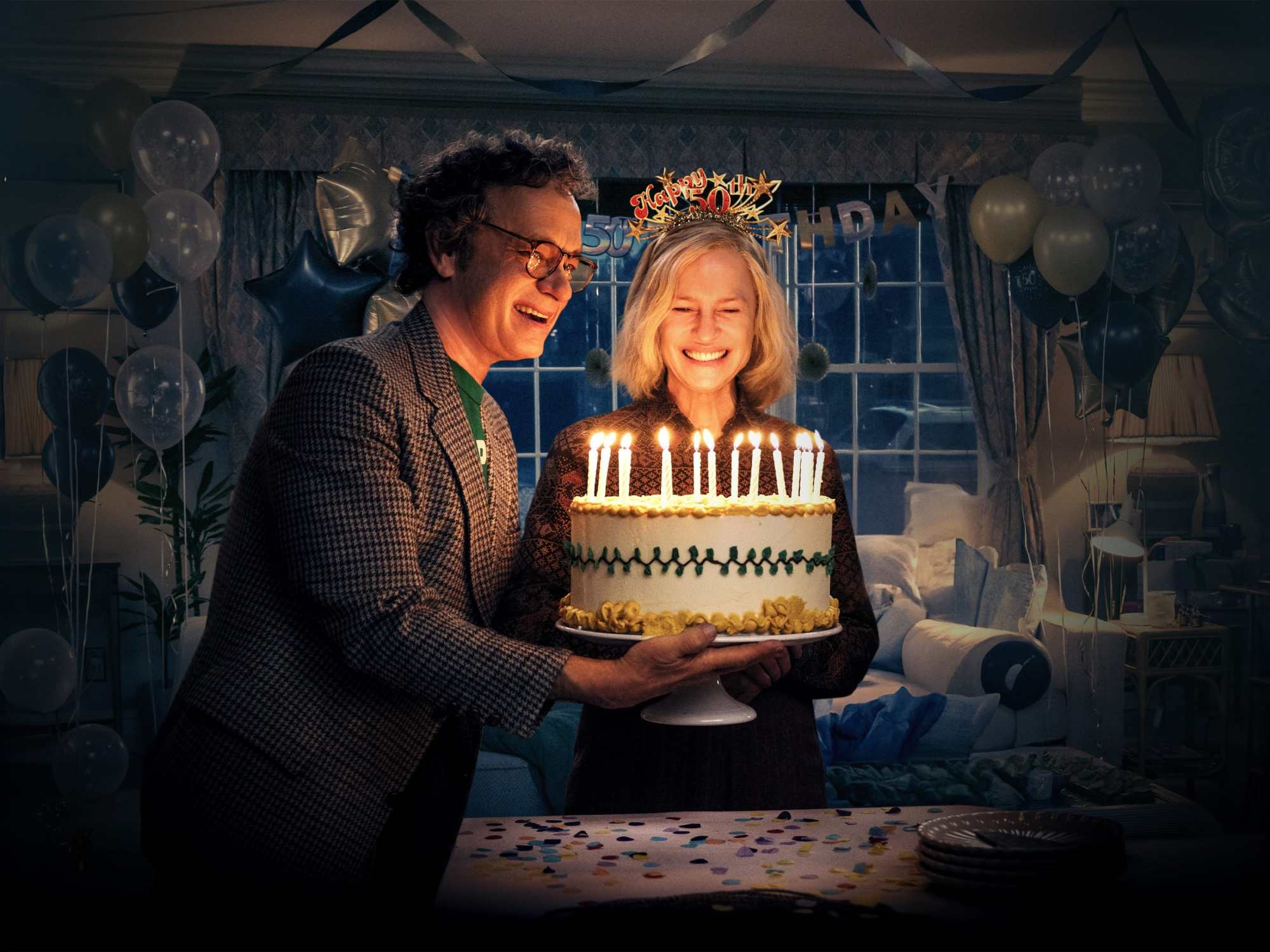
Throughout this year, I’ve had the opportunity to delve into 95% of Robert Zemeckis’s filmography, revisiting old favorites and discovering new gems. Zemeckis’s impact on the film industry is undeniable, as he continually pushes the boundaries of technology and storytelling. However, his recent projects have left some of us with mixed feelings, as we navigate the changing landscape of his long and illustrious career. Seeing how he went from the Back to the Future trilogy and Who Framed Roger Rabbit to whatever Pinocchio failed to be, who knows what comes up next? The last film that was a box office success was Flight, while The Walk was the last to receive positive reviews from critics and audiences. With his latest Here, there was some promise to be had since it’s a collaboration that sees a Forrest Gump reunion between screenwriter Eric Roth and stars Tom Hanks and Robin Wright. If you’re thinking to yourself, this will be an unforgettable viewing experience, the fascination from this experimental narrative won’t always feel cinematic.
What’s the Story: From the pre-historic age when dinosaurs were wiped out to pre-colonial times, a Pennsylvania land located across the street from Benjamin Franklin’s son’s estate is where the Young family lived through generations is something to behold. Richard (Hanks) was raised by his parents, World War II vet Al (Paul Bettany) and Rose (Kelly Reilly), and later introduced them to his high school sweetheart Margaret (Wright). Soon, they have a daughter when they’re still teenagers, get married, and live through the dramatic ups and downs of their lives in this one home.
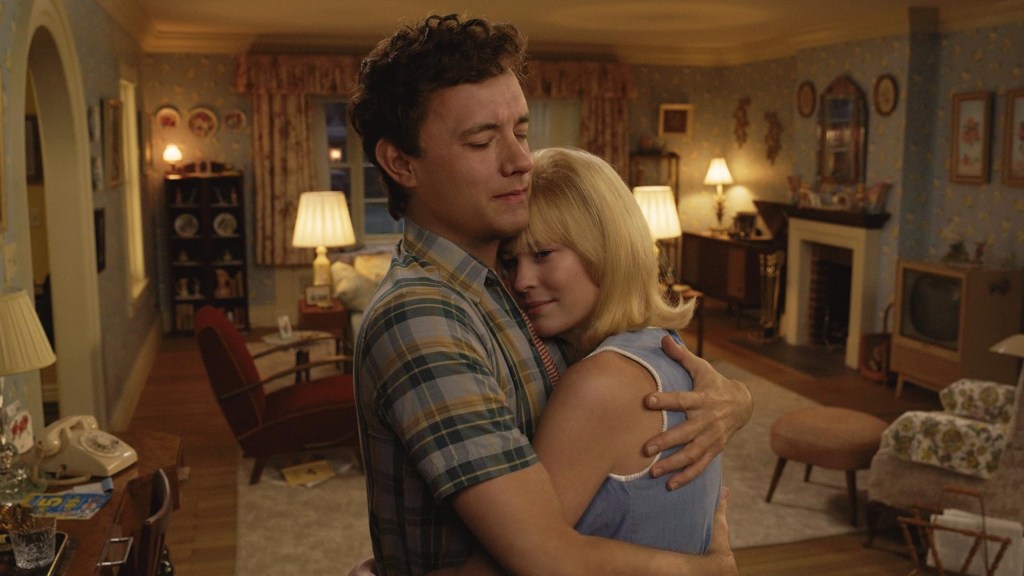
Normally, I would’ve said I never read the source material. But I have read Richard McGuire’s 2014 graphic novel of the same name, which was expanded on a comic strip. Since the movie was coming out, I checked it out from the library (work) a few months back out of curiosity. As it turns out, it’s pretty inventive and creative going from page to page, realizing you never know what can occur in a single location. So, being familiar with what came before and still refreshed in my mind, it was a question of whether Zemeckis could bring this idea to life in this one fixed spot: the living room. And it’s a narrative that has a hard time keeping the interest alive for 104 minutes. It’s not as pretentious as A Ghost Story, but it feels more like a gimmick for an older audience.
Having Here presents itself as a passage of time had the potential to be profound in how time flies by for everybody. However, given how unique it sounds to see everything from the past to now, the camera’s focus on a single room limits the exploration of more profound themes about the ways of life through holidays and important moments in history.
Sometimes, it felt like I was sitting through an expensive Broadway play during its first run with a good score by Alan Silveri. Because it’s not told chronologically, as I thought, its structure is similar to that of a graphic novel, using lined squares to transition to the different periods. But the problem is growing tired of the exact location without the camera moving when we only imagine what’s going on on the other side and do not feel any emotional connection to its characters. In addition to Richard, Margaret, and his family, we travel back to an aspiring pilot, John Harter (Gwilym Lee), and his wife (Michelle Dockery) in 1900, an inventor (David Fynn) who created La-Z-Boy Recliner in the early ’40s, to the present with a black family facing the COVID-19 pandemic. Many characters go back and forth on-screen, yet you need a stronger connection to these plot lines since it’s the typical American lifestyle almost everybody goes through, struggling with the economy to give up a specific dream to support a family. There’s a noticeable lack of attention given to the experiences of the Indigenous People and the Black family. A scene where parents advise their son on how to act if stopped by a police officer abruptly introduces a discussion on race. By its nature, this discussion is brief and fails to engage the audience meaningfully.

It’s great to see Hanks and Wright work together again after their chemistry as Forrest and Jenny 30 years ago. But I wouldn’t go that far to say their performances in this are great. Maybe because their love story seemed to rush to get to know them more, but it felt like watching actors play out the script rather than seeing them as other people. On the other hand, Bettany gave the most robust performance even though he plays the typical patriarch who loves a drink and doesn’t understand his oldest son’s passion for art. It shows he’s a great actor who can elevate so-so material. Plus, with Zemeckis always wanting to push new technology in film, the de-aging effects from Metaphysic’s AI to use in live shots didn’t impress me too much. I never bought Hanks and Wright as teenagers when looking like they came straight out of Bosom Buddies and The Princess Bride, respectively. Sometimes, it looked okay; other times, it was a little distracting when it was close to someone’s face or, in this case, the last two minutes.
This one tried to give me those moments to shed a tear or two, but it never did since it can appear manipulative in a predictable fashion. I walked out, knowing it would be a while for Zemeckis to get his hands on a story that checked off the boxes that made him a true artist. A serious Oscar contender, this isn’t.
With Here taking an ambitious approach to the slice-of-life perspective, Robert Zemeckis’ adaptation doesn’t always translate perfectly when it feels too corny for its own good and not getting the best out of its actors.

 DC's Take