
About two weeks ago, I attended the Heartland International Film Festival in Indianapolis for my fourth year in a row. It’s also a wonderful opportunity every October now where the film fans in town can see possible Oscar contenders, with maybe one or two ending up as some of my favorites. This year, I got the chance to see four films I was most interested in when they were announced. The only one I wanted to check out was Nickel Boys, but unfortunately, it conflicted with another screening. Not that I regretted missing it, but it’s up in the air when I see it when it got pushed back to December in a limited release. So, this is a post covering what I saw and giving my early/ late thoughts on what will be on everyone’s mind by this year’s end: A Real Pain (Searchlight Pictures), Nightbitch (Searchlight Pictures), Sing Sing (A24), and Emilia Pérez.
‘A Real Pain’
Since I’ve been out of the loop of not catching anything from Sundance this and last year at home, A Real Pain was the one that was on my radar the most, especially since Searchlight Pictures picked it up shortly after for $10 million. We have ourselves the second feature film from writer/director and co-lead Jesse Eisenberg, and it had me curious about what he’ll do next since I wasn’t a fan of his directorial debut, When You Finish Saving the World. But if you’re like me and love quiet road movies that make us feel any amount of connection to their characters, then you’re going to love what will hopefully be a true awards contender this fall. Plus, it’s the kind of feel-good dramedy in the vein of Little Miss Sunshine that uplifts and brings hope, almost helping me after feeling emotionally overwhelmed around the time I saw it.
What’s the Story: Cousins David (Eisenberg) and Benji (Kieran Culkin) Kaplan travel to Poland to explore their family roots after their beloved grandmother died. At first, they were very close growing up, but their relationship became more restrained as time passed. David has a family and is constantly working as a graphic designer, while Benji doesn’t have a job at the moment. They take part in a tour group with fellow tourists to explore the historical landscapes in Poland before visiting their grandmother’s old home to honor her.

This question loomed in my mind as I wondered if Eisenberg could improve with his second time behind the camera. And the answer is a resounding yes. What seemed like a personal story he wanted to tackle, A Real Pain felt more like a better first feature than he did two years ago. It’s a conventional story to follow for 90 minutes. Still, this melancholic sense of fun gave it this Woody Allen vibe throughout, except the public will widely accept it. The trip they’ve been planning gives them a chance to catch up and reconnect in the memory of a loved one and what can be described as “pain” in their surroundings.
What A Real Pain gets right is the perfect balance of humor and heart, which is what every lighthearted film should always aim for. It’s been a while since I had some hard laughs in the theater, and there were so many jokes so funny the audience I saw it with probably forgot what somebody said afterward. But there’s a credit to Eisenberg’s writing this time in how this journey through Poland deals with the Jewish culture then and now and how it isn’t always easy to understand what loved ones go through in times of struggle. As simple as this was, it makes you think of a buddy/ road movie and prompts a deeper self-reflection.
The true magic of the film lies in the natural dialogue and on-screen dynamic between Eisenberg and Culkin. Their portrayal of mismatched cousins is a delight to watch, never losing its charm in any scene. Eisenberg, known for his consistent character portrayals, brings a unique touch to David, a character who is more reserved than his cousin. Yet, his concern for Benji is palpable, especially in a revealing monologue at dinner. By far, it’s the best I’ve seen from him since The Social Network. Once it’s over, you won’t stop thinking about how amazing Culkin is as Benji. His character is the kind of guy who lights up the room with unpredictable charm, proving he has always been designed as a scene-stealing actor during his Succession days. He had the funniest moments since Benji usually speaks his mind, which can annoy David, but he knows he was close to their grandmother. Sweet and emotional, yet unsure what he’ll say next, this is the first this year where I could see Culkin land an Oscar nomination for Best Supporting Actor since it seems like a light year in the category.

Eisenberg’s direction didn’t have to be flashy, but its flow made us think we were a part of this trip visiting the important Jewish landmarks. Set to classical piano music, including the piece “Nocturne op.9 No.2,” it has a hilarious scene of when they’re at the Warsaw Uprising Monument, and David’s the only one taking photos with everyone’s phones since he doesn’t want to be in the pictures. But the tour sequence visiting the Concentration Camp was haunting, and I appreciated how it took itself seriously. The serious tone added a layer of emotional impact, making it more effective, considering it was shot on location.
In the end, A Real Pain quickly established Eisenberg’s talents, more so with its sophomore feature. Funny and easing you in to resonate with its two characters, it’s an impressively beautiful film made all the better with Eisenberg and a possible career highlight in Culkin’s work.
Grade: A-
‘Nightbitch’
There were some key aspects of Nightbitch that made me eagerly anticipate its release. For one, it features the always captivating and talented Amy Adams. It has dogs. It’s the next project from the acclaimed writer-director Marielle Heller, known for her work in Can You Ever Forgive Me? and A Beautiful Day in the Neighborhood. And it’s an adaptation of Rachel Yoder’s 2021 best-selling novel. Even though the trailer left an unimpressed reaction from me and everyone else online, that had to prove me wrong to get on board with the strange premise it’s tackling as this allegory for motherhood. Maybe it’s just me, and I didn’t have the exact feelings as everyone else walking out. But I thought Nightbitch is an okay dark comedy that’s not great but can be simply admired for how out there it can appear.
What’s the Story: Mother (Adams) is a stay-at-home mom raising her two-year-old son (Arleigh and Emmett Snowden). The day-to-day routines of cooking breakfast, cleaning up messes, and tired of going to the mother-child activities at the library with other mothers are the complete opposite of when she used to work as an artist. She gave up her career and is usually alone at the house while her husband (Scoot McNairy) goes on business trips. She doesn’t always tend to her child since her mother is always “on call.” She then starts to lose herself, letting her frustrations play through internal monologues and believing she’s becoming a dog. Maybe it’s because she notices fur on her back, her teeth sharpen, and she starts attracting stray dogs at the park.

When you first hear the seemingly absurd premise, it’s easy to form expectations. I, for one, anticipated a blend of Jason Reitman’s Tully and the ’80s classic An American Werewolf in London. However, Nightbitch turns unexpectedly, leaning more towards a fantastical, dark comedy than a typical body horror. It was a disappointment, at least for me, that it didn’t go further in being weirder about why/ how she was turning into a dog. Despite not having read the source material, Heller’s portrayal of the Mother as tirelessly overworked, yearning for a way to cope with the stress and anxiety of early parenthood, is a narrative that most mothers can relate to. It’s a portrayal that raises the question: will the challenges of raising children improve as time passes?
But I wouldn’t throw this under the horror category since it offers more laughs than expected. The crowd I saw it with was eating it up, which gave me some chuckles. Though never shocking, except when Mother discovers she has a tail growing out of her. Even when I wished there was a distinctive tone to settle on, it helps that the writing has a fair play of how her mind works with the different personalities of these other moms. It was a metaphor that didn’t push further in how it wants to navigate what Mother’s going through.
If for nothing else, this film is worth seeing for Amy Adams, bar none. She’s been one of my all-time favorites to look forward to, but it’s disheartening to see her talent underutilized in films between Hillbilly Elegy and Disenchanted. It’s been years since a movie has truly showcased her talents. Would I go out of my way to say this is one of the top 10 best performances she’s done? No, but when she commits to Mother, Adams doesn’t seem to hesitate with this role. One would hope she had a different experience when raising her real-life daughter, but he shows the pressures of feeling unneeded or exhausted. But to find her freedom in what she’s been missing for the past couple of years. Plus, she can give off these pissed-off stares that will shut anyone up if the wrong thing is said. And it can be amusing having her throw in some woofs and growls to her kid, which means eating meatloaf and mac and cheese with her face, with everyone around thinking she’s on drugs. It was also great to see Scoot McNairy show a completely different parenting dynamic while also showing that he isn’t particularly a bad guy. But the long run shows he’s an oblivious husband sometimes.

There were some flashback sequences around her childhood I heard weren’t from the book and were for the film that she wanted clearance on. I also thought they should’ve had more time on the book she checked out from the library from Jessica Harper’s librarian since that plot point had more to do inside the book, so I’m told. And what other film this year will have montage set the strangest needle drop of the year: “Weird Al” Yankovic’s “Dare to Be Stupid.” After sleeping on it, I’m hopeful that a rewatch might reveal more layers and make me like it more.
Overall, Nightbitch only sometimes works from the premise perspective, but those who’ve read the book or have an idea of how it’ll turn out will be pleased, especially with Amy Adams’s winning performance. Even a week after I saw it, I still had mixed feelings about it, which left me wanting more.
Grade: C+
‘Sing Sing’
Since its debut at last year’s TIFF, I’ve been eagerly waiting to see if the buzz surrounding Sing Sing was accurate. The news that it would play during Heartland added to my excitement. Despite its limited release in just two theaters this past summer, I could not catch it. It was also uncertain when A24 would release it on VOD, which only added to the film’s allure. Having finally seen it, I can confirm that it’s a film that’s genuinely gaining attention, thanks to co-writer/ director Greg Kwedar’s creation of this year’s most empathetic drama that shouldn’t go unnoticed.
What’s the Story: Inside the Maximum-security prison of Sing Sing Correctional Facility in New York, John “Divine G” Whitfield (Colman Domingo) is serving time for a crime he didn’t commit. Every six months or so, he and his fellow inmates participate in a small theater group as part of the Rehabilitation Through the Arts (RTA) program. There is where they perform a variety of original and famous plays to restore their sense of freedom. Courtesy of their theater director Brent Buell (Paul Raci), they’re about to begin production on their latest called “Breakin’ the Mummy’s Code,” with the newest member to the troupe Divine Eye (Clarence Maclin) joining.
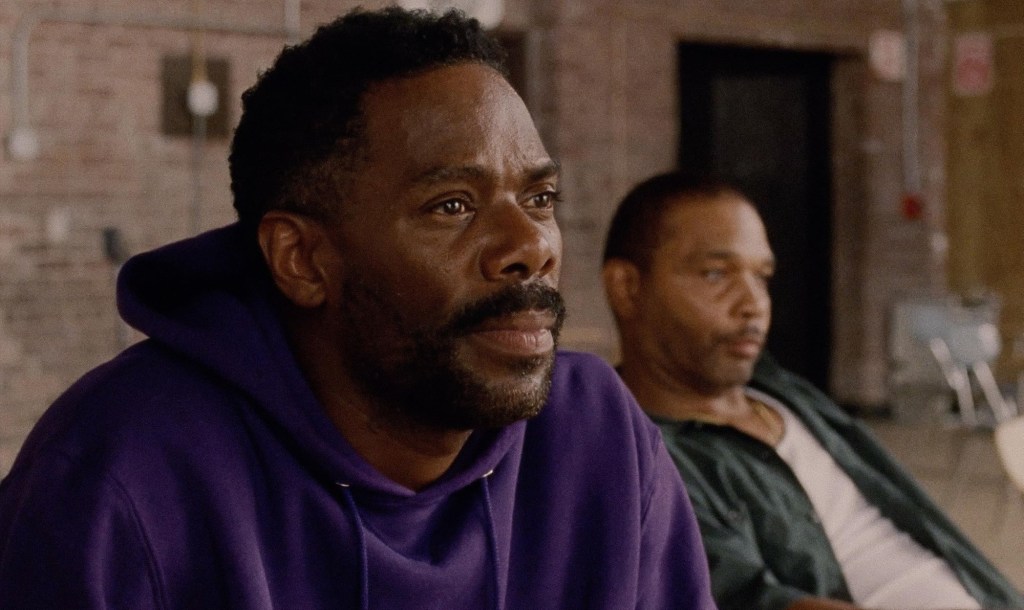
Considering how its primary setting is all in this prison, it would be easy to assume this would fall in line with classic dramas such as The Shawshank Redemption or Cool Hand Luke for modern times. In my mind, it reminded me of Short Term 12 and Nomadland. Sing Sing is fascinating because it’s based on an actual program established in 1996. With no violence within the walls or anyone taking into rival gangs, Kwedar takes on a documentarian-like perspective of this quiet environment. Even those who didn’t grow up as theater kids might find a deeper meaning in how these men put their creative minds into works like Shakespeare. The idea of “Breakin’ the Mummy’s Code” may sound outlandish with its elements of time travel, gladiators, and Freddy Kruger. However, it’s all about trusting in the process for a system that sometimes fails to recognize them to stand on their own. This process is a way of reforming themselves and experiencing the artistic side they have never explored, a journey that will surely engage your imagination.
Everything Kwedar captures through its slow burn is highlighted in this sense of claustrophobia (on 16mm film) while feeling free to see how this community works. This group, which you’ll feel a part of, gets this glimpse of escapism in performing, and though we see the preparation from training exercises and rehearsals, it brings together a sense of redemption, especially for Divine G, to know we’re all capable of doing so.
Domingo has slowly become one of my favorite actors with the project he’s attached to, and he started to look up to him as a fan. His performance here is incredible, a testament to his talent and dedication. Divine G, a skilled playwright, is revered by his peers and is seen as a mentor. His love for the theater is palpable, yet he yearns for a life beyond its confines, hoping his upcoming parole hearing will bring the freedom he desperately seeks. Everybody has a breaking point, but who knows when it will hit? There’s so much charm and compassion to this role that’s even better than his Oscar-nominated performance in last year’s Rustin. A name everyone will talk about is Clarence Maclin, who is also known as Devine Eye. He, too, is amazing. It’s unsure what taking part in RTA would do for him. He and Devine G started not seeing eye-to-eye, with the former suggesting doing a comedy and getting the part of Hamlet. But things resolve through a mutual relationship that builds the bond around the film’s heart.

Sing Sing is so authentic because it has a mixture of professional actors like Domingo and Sound of Metal‘s Paul Raci in an excellent supporting role and the real-life former incarcerated inmates who were in the RTA program playing themselves. Having them be them was tricky since they had yet to act. Kwedar attended the screening and had a Q&A with the audience. I talked to him afterward and asked him if it was difficult. He said something along the lines of how the dynamic of everybody involved is so natural and a way to remember their past, channeling their joy while there. One scene that stood out was this exercise, where they closed their eyes and remembered a moment that made them happy. That entire scene emphasizes how inmates had lives of their own that they hoped to get back to.
Humanity is always remembered, even when the story adds some levity to avoid making it too serious than expected. I cared for the characters to make this strange play work out and find any amount of peace they could perfect. In terms of awards, I could see nominations for the Independent Spirit Awards. But for the Oscars, there’s a good chance it might get into Best Adapted Screenplay, and I’d love to see Domingo get his second Best Actor nomination two years straight.
Through what it means to get a second chance and the ability to feel perfectly authentic, Sing Sing is a beautiful drama that takes its time to breathe you in with its remarkable true story.
Grade: A-
‘Emilia Pérez’
Lastly, one of the films that took everyone by surprise at the Cannes Film Festival was Jacques Audiard’s latest, Emilia Pérez. The film, which won the Jury Prize and saw its four actresses share the Best Actress award, was not on many people’s radar. I, for one, didn’t have any real expectations going in besides being curious about how this would be a hybrid of a crime drama and a musical. Throughout the French filmmaker’s film, who’s best known for A Prophet, Rust and Bone, and The Sisters Brothers, the vibe I certainly was if Alejandro González Iñárritu and Pedro Almodovar made something together. By that, Emilia Pérez will be one that will have a good amount of viewers split. I didn’t walk out loving it as much as I wanted. And the results just come across as messy, leaving me conflicted about what Audiard wanted to say.
What’s the Story: Mexico City defense attorney Rita Mora Castro (Zoe Saldaña) feels underappreciated at her job when defending scums. After she gets kidnapped by drug cartel leader Manitas Del Monte (Karla Sofía Gascón), he asks for a request she wasn’t expecting. He needs help leaving the country and finding a doctor to perform a sex change operation, something he has desired since childhood. This would mean making arrangements for his wife Jessi (Selena Gomez) and their two children to move to Switzerland, leading to faking his death to leave the life of crime behind and later emerging as a woman named Emilia Pérez.

On the surface, what makes Emilia Pérez work are its three actresses. We all know Saldaña always shines in the huge blockbuster franchises (Avatar, MCU), but it feels great seeing this underrated actor in her best role yet. as Rita. She’s offered $2 million to make this work, and once Rita realizes the new Emilia while living the best she can, it’s almost like her life is changing once again. Her journey to reunite Emilia with her family adds a dramatic twist to the narrative. Also, who would’ve thought she could sing and dance? But Karla Sofía Gascón’s performance as the titular character will receive the most attention. It’s great seeing openly trans actresses get the spotlight as someone seeking redemption while discovering her new identity and regretting past mistakes. It’s safe to say it’s one of the year’s best performances. Even Selena Gomez turns in one of her best works in a film, which can utilize her well. Nothing here is enough to warrant talks of a Supporting Actress nomination for Gomez, but it’s sometimes rare to see her in anything decent on the big screen.
Audiard’s eye for ambition is fully displayed but doesn’t always make for a perfect experience. The first half hooked me with Manitas’ decision to transform from a ruthless warlord to a woman leading for change by helping families of victims of violence in Mexico. The musical sequences had this essential flair with the choreography. But as for the songs themselves from French artist Camille, it doesn’t help when I can’t tell you one song that stood out. There was a point where nobody was singing for long stretches of time. I wanted more of those moments.
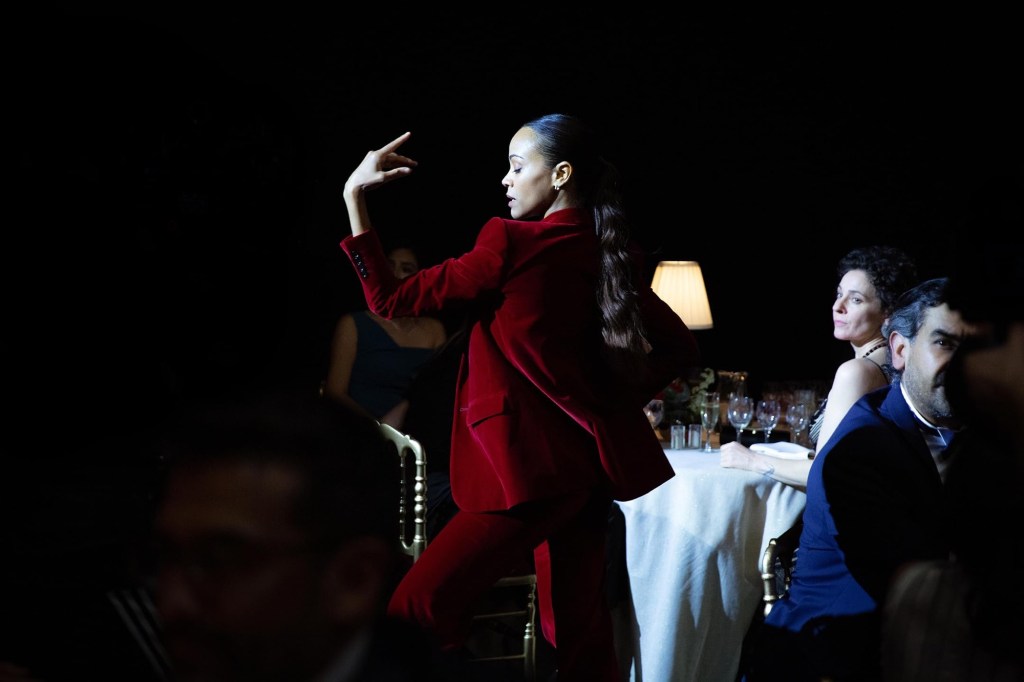
It’s about midway through when it wasn’t emotionally pulling me in. It started to lose sight of caring about the facets of Emilia’s journey in reconnecting with her kids and Jessi, with them only knowing her as a cousin they never knew about. This goes in a direction that feels like a melodramatic opera with a vision that almost came through. But the third act didn’t always work, with an unpredictable turn that left me unfulfilled.
Overall, Emilia Pérez‘s grapples with important issues such as self-discovery. While it may appear flawed in its execution, there’s still mileage to gain from its three main performances and vibrant style. Coming from someone who hasn’t seen prior films from Jacques Audard, it might appeal more to those familiar with his work. As it ended, something tells me this will be the most divisive award contender. Since Netflix is releasing it, they might put out a strong campaign behind it, but it depends on the audience’s reactions.

 DC's Take