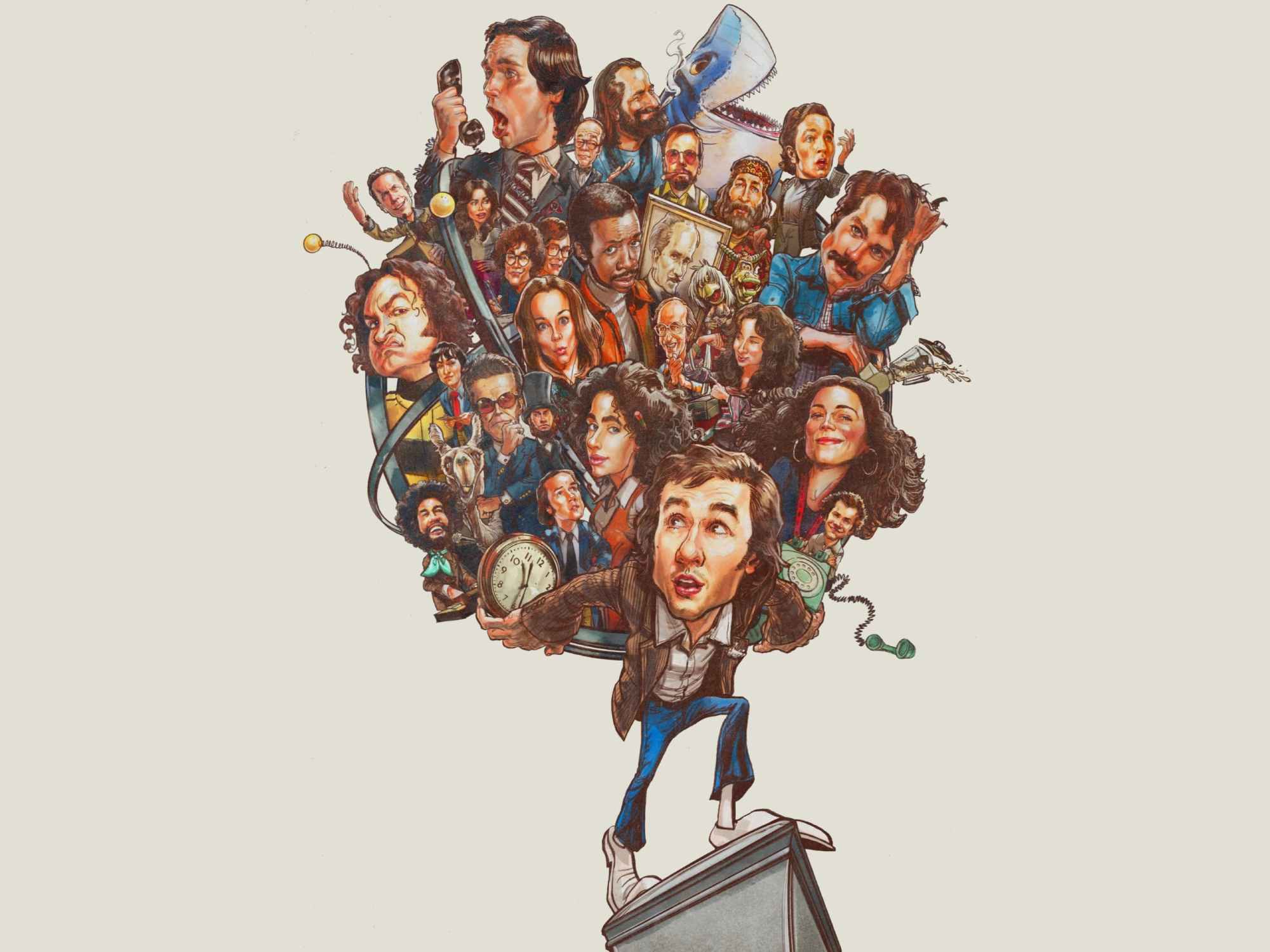
If any film coming out this fall were tailor-made for me, it would be either the upcoming Robbie Williams biopic Better Man or Jason Reitman’s latest Saturday Night. When I first heard Sony had plans to make a movie about the creation of a celebrated sketch show, I was hopeful. It had to be great. I’ve watched SNL since I was eight or nine years old and continue to grow up with it to the point of remembering every episode from season 29 onward. The show’s early years changed the landscape of comedy forever. However, I never realized that something happened before it went to air. My expectations were solid going into this. And when you have a biopic retelling everything leading up to the landmark broadcast, I couldn’t have asked for a better time because Saturday Night has to be Reitman’s best film in 15 years.
What’s the Story: On the night of October 11, 1975, in New York, a young Lorne Michaels (Gabriel LaBelle) is set to air the very first episode of NBC’s Saturday Night inside the iconic 30 Rock building. The blueprint surrounding the variety show is how it became popular. Celebrities took on hosting duties. They laughed through hilarious and satirical sketches. They were entertained by memorable musical guests. Beginning at 10 PM, everything leading up to 90 minutes proves to be a chaotic experience from every corner. So much is riding on making it to air that they have a rerun of The Tonight Show with Johnny Carson on stand-by if anything goes wrong.
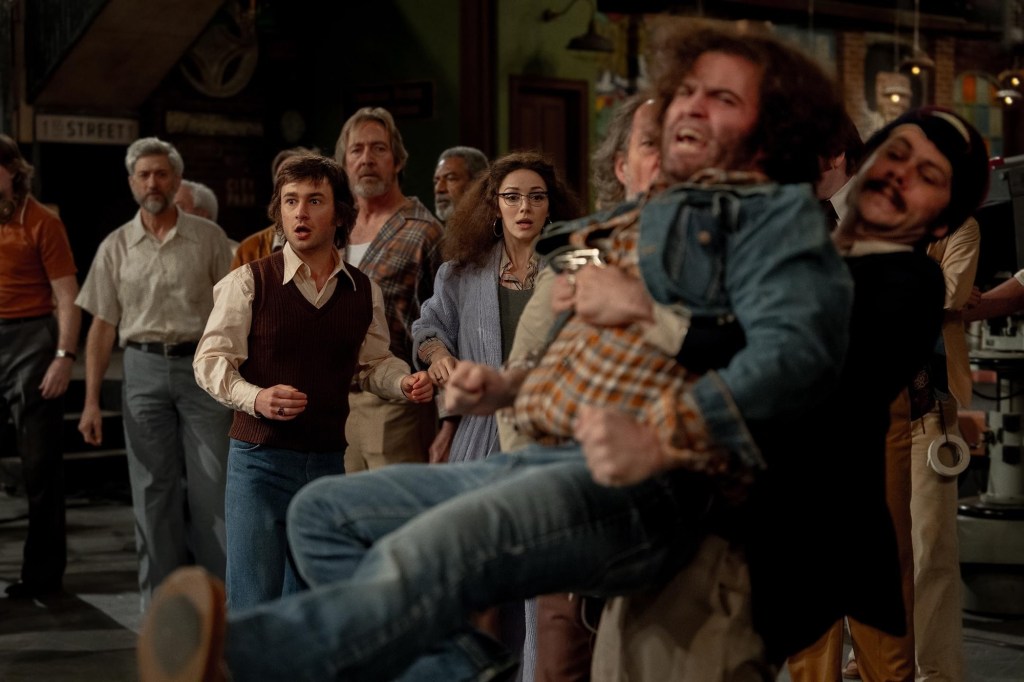
Just when you thought Saturday Night would give the complete rundown of how everything came to be throughout an entire week, it all starts on that night nearly 50 years ago. You hope the trials and tribulations won’t go wrong. Coming from someone who has watched a lot of SNLs to this day, I thought everything ran as smoothly as possible before airtime. But that was in the ‘70s, and it had to be a challenge for those involved, which was totally different decades later. Shooting the first episode of anything is already anxiety-inducing since you never know what the reactions will be or worry about decisions. Reitman and his co-writer Gil Kenan centering around the lead-up was the smartest decision to make it work, and they did. For 109 minutes, Reitman made us feel like we’d traveled back in time. It was like being a fly on the wall, experiencing the highs and lows of the preparation. By that, it’s a film we haven’t seen from him before, not just a simple character study.
Saturday Night feels like Reitman was channeling his inner Aaron Sorkin when he wrote Steve Jobs. Here you have one of this year’s sharpest screenplays to ease into with its dialogue, even if some details might be dramatized. He lets this true story unfold in a hilarious and time-consuming fashion where it’s hard to believe it wasn’t perfect. Lorene’s unwavering determination that we’re following on this intense mission, where every detail must be perfect before 11:30. There’s no consideration of postponing to next week, no room for doubt. The narrative, unfolding almost in real time, heightens the tension despite our knowledge of the first show’s outcome. The film is a whirlwind of challenges. The sound issues during dress rehearsals and the unfinished sets add to the chaos. Guest host George Carlin (Matthew Rhys) expresses dissatisfaction with the show’s format. Garrett Morris questions his role in the cast due to his race. The decision to cut sketches to avoid a three-hour show was perhaps the most difficult. Unfortunately, this meant Billy Crystal’s (a spot-on Nicholas Podany) stand-up didn’t make it. Despite these hurdles, the film’s fast pacing keeps you engaged. Only a couple of scenes slow down the exhilarating ride.
Since his breakout in Steven Spielberg’s underrated drama The Fabelmans, everybody knew LaBelle would be a star to look out for. Who would’ve guessed he’d portray another legend in the field of entertainment? His take on the ongoing producer/creator shows his stress in succeeding. He works hard to prove doubters wrong by making a late-night sketch show with then-unknown actors succeed. A lot of screen time is spent on him, yet his performance doesn’t disappoint. It gives us a glimpse of who Michaels was without giving a straight-up impression of how we view him now. But this has a stacked ensemble with a good amount of screen time they all had.
Aside from LaBelle, there’s Cooper Hoffman as NBC Vice President of Programming Dick Ebersol (who would become Executive Producer for the show for four years), Rachel Sennott as Lorene’s estranged wife/ writer Rosie Shuster, Tommy Dewey as head writer Michael O’Donoghue, Nicolas Braun in dual roles as legendary Muppet puppeteer Jim Henson and the surreal comic Andy Kaufman, and frequent Reitman collaborator J.K. Simmons as comedian Milton Berle (who later hosted during season four and was labeled one of the worst hosts).
But for the casting of the “Not Ready for Primetime Players” longtime fans are familiar with, it’s pretty damn impressive. There’s Dylan O’Brien as Dan Aykroyd, Cory Michael Smith as Chevy Chase, Kim Matula as Jane Curtin, Emily Fairn as Laraine Newman, Ella Hunt as Gilda Radner, Lamorne Morris as Garrett Morris (no relation), and Matt Wood as John Belushi. The current cast may not mirror the original cast in appearance. However, their commitment to embodying the spirit of their characters is genuinely engaging. In the trailer, Smith’s portrayal of Chase’s ego is a prime example. Chase’s conviction that he’s above everyone else is apparent. This is especially evident when network executive David Tebet (Willem Dafoe) foresees his rise to stardom. When I heard Hunt would play Radner, I felt excited. She is one of my favorite cast members. This had to be the opportunity to show the English actress she has range. It makes me hopeful to see her in more roles in Hollywood. And I didn’t know how to imagine O’Brien as Dan Aykroyd, but he completely sold me with every scene he’s in, perfectly hitting certain mannerisms.
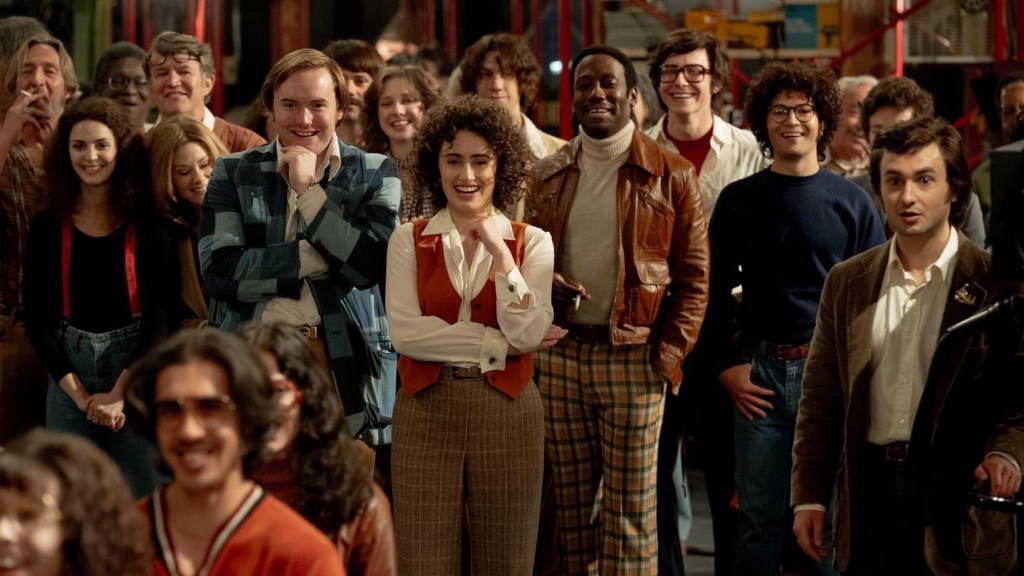
Reitman effectively focuses on the stakes. He examines whether the cast, crew, and writers have what it takes to make it to air. The problem might be that it lacks time for emotional depth. But since he loves the series and worked as a guest writer in 2008, it’s more of a nitpick from me. There were a few excellently crafted short but long takes to show off the studio and backstage. They also show how everyone takes on their job. This almost reminded me of Birdman‘s style. Eric Steelberg’s 16mm cinematography felt authentic and glued me immediately into the final scene. An aspect that shouldn’t be overlooked is the production design’s ability to recreate the look of Studio 8H from its heyday. Even though I’m still young, it still feels special.
However, its energetic feel might prompt us to think about whether the hard work pays off. It is something to be proud of. It’s like starting the work day out of touch and ready to go home. You and your team put in the work to get a huge chunk of what today has in store. You go home with relief. This film might not be the most inspiring one out there. Still, I intend to root for the underdogs. We recognize when it’s good like this. Are we looking at the film as an Oscar contender? That really depends on whether people will see it despite the positive reviews. However, the film’s potential for awards recognition, particularly in Best Original Screenplay, Editing, and Production Design categories, gives us hope. Unlike his two best efforts, Juno and Up in the Air, it’s unlikely to get into Best Picture. But one could hope to be a surprise this awards season.
Overall, Saturday Night is an incredibly sharp biopic chronicling the program’s birth in a captivating environment. Topped with a memorable ensemble led by LaBelle and enough nostalgia to please older fans, it’s nothing but a great time courtesy of writer/director Jason Reitman. I loved it. Not everything he’s released in the last decade has reached a great level. Yet, we’re looking at one I can see myself rewatching.

 DC's Take